Construction Dive’s Friday Punch List is a series dedicated to sharing major building headlines that contractors may have missed from the week.
In another busy week for construction news, FlatironDragados reached substantial completion on a $133 million segment of a North Carolina highway megaproject, and the New York City Department of Buildings continued to release details on the fatal building collapse in Brooklyn.
Read on for more news construction execs shouldn’t miss.
Maryland awards $39M demo contract on Key Bridge rebuild
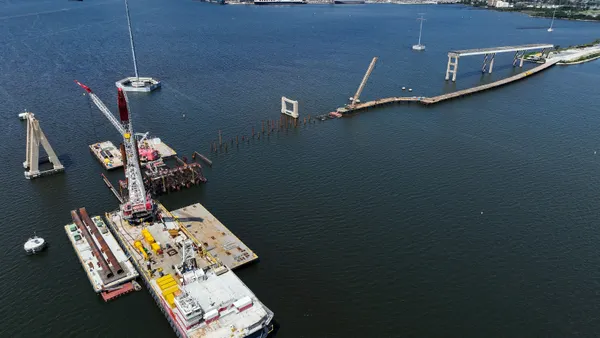
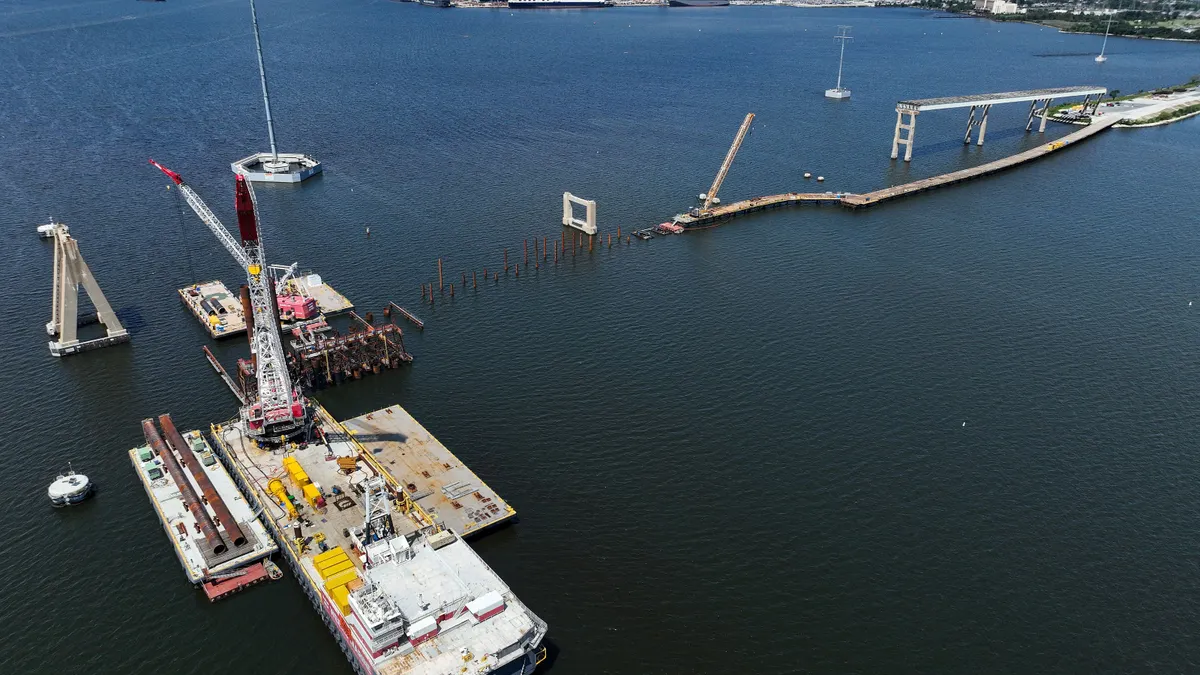
The Maryland Transportation Authority has approved a $38.6 million demolition and miscellaneous marine work contract to Pittsburgh-based Joseph B. Fay Co., according to a Thursday announcement. The company will work to clean up the remnants of the Francis Scott Key Bridge in Baltimore, which collapsed in March 2024.
In February, crews finished mechanically removing the land-based portions of the bridge, including over 20,000 tons of concrete decking and columns. Now, Joseph B. Fay will remove and salvage steel spanning over the Patapsco River, demolish 10 piers from the former bridge, remove nine marine foundations and clean out 96-inch-diameter steel pipe piles for pouring concrete on the new bridge.
The MDTA invited contractors to submit proposals for the contract this summer. The contract was awarded to the lowest-priced, qualified bidder, per the release.
The contract is one of four planned procurements to replace the Key Bridge, with the others focused on constructing the span itself. The MDTA estimates the jobs will collectively cost between $4 billion and $4.8 billion. The next award is the South Land Approach, set to advertise in the next few months and begin construction in spring 2027.
—Zachary Phillips
NYC Department of Design and Construction names its first deputy commissioner
The New York City Department of Design and Construction appointed Thomas Wynne as the agency’s first deputy commissioner, according to a Wednesday news release.
In this new leadership role, Wynne will provide strategic direction, collaborate closely with senior staff and represent the agency across the design and construction industry, according to the announcement. Wynne most recently served as deputy commissioner of infrastructure at the NYC DDC, where he oversaw a team of 400 professionals and managed the agency’s $15 billion infrastructure portfolio.
Wynne won the Municipal Engineer of the Year in 2023 by the Municipal Engineers of the City of New York, according to the release. He is an active member of the American Society of Civil Engineers and holds a B.S. in civil engineering from Columbia University.
—Sebastian Obando
Granite wins $26M California groundwater contract
The Coachella Valley Water District awarded Granite Construction a $26 million contract on the Whitewater River Channel & Palm Desert Groundwater Replenishment project in California, according to a Nov. 18 news release.
Scope of work includes the construction of a wetlands habitat near North Shore of the Salton Sea along with concrete slope protection and groundwater replenishment ponds in the Whitewater Channel located in the City of Palm Desert, according to the release. The contract value will be included in Granite’s fourth quarter 2026 committed and awarded projects.
Granite expects construction to start in January 2027 and to complete in February 2028, according to the release.
—Sebastian Obando
Skanska leverages tech on California mental health center
Stockholm-based Skanska has completed the 77,000-square-foot Cordilleras Mental Health Center Replacement project in Redwood City, California. The facility, built for the County of San Mateo, replaces an outdated 1952 tuberculosis hospital and is the first behavioral health campus in the state designed to achieve net-zero energy, according to a Tuesday announcement.
The new campus includes 121 beds distributed across five new buildings, per the announcement. Four single-story mental health recovery centers each accommodate 16 occupants, and a central, three-story co-housing building counting 57 beds. The buildings are arranged around an open space with outdoor seating, gardens and recreation courts.
The facility utilizes advanced sustainable systems, including energy recovery units and low voltage lighting, per the release. Onsite rooftop and canopy mounted solar panels will offset the power requirements of all mechanical and operational systems, according to Skanska.
The contractor partnered with CannonDesign on designs and utilized BIM technology and Dusty Robotics to automate layout design and ensure precision, the release said.
—Zachary Phillips