

Dive Brief:
- Clark Construction advanced major structural upgrades for the Metro system in Washington, D.C., within a 56-day sprint last summer, according to an Oct. 29 news release. The Washington Metropolitan Area Transit Authority says the work at the Bethesda and Grosvenor-Strathmore Metro stations was delivered on time and on budget.
- Improvements required the locally headquartered builder to conduct specialized demolition, removal of materials and replacement of tracks. In Bethesda, crews also constructed a new mezzanine, designed to connect the Red Line with the Maryland Transit Administration’s future Purple Line light rail, slated to open next year.
- The civil arm of the Bethesda, Maryland-based contractor has a 50-year history of work on the WMATA’s Metro transportation network, and it detailed the complex work required to deliver the project on a tight schedule.
Dive Insight:
Following a 44-hour demolition in November 2025 at the Bethesda station, Clark Civil’s teams erected heavy steel, applied fireproofing and placed structural concrete within the station.
In December 2024, the Washington Post reported the cost of the mezzanine had grown, inflating from an estimated $2.4 million in 2016 to $52 million. Both WMATA and Clark Construction did not respond to Construction Dive’s request for comment on current construction costs.
Simultaneous to the Bethesda station work, 3 miles away Clark performed the first major overhaul of the Grosvenor-Strathmore station since its 1984 opening. With specialized remote-demolition robots, crews removed over 18,000 square feet of platform tile and concrete topping slab, according to the news release. They replaced 1,200 linear feet of track edge along the 600-foot platform.
The contractor’s detailing of the projects described them as “a unique puzzle.”
“Months of preparatory work between project partners took place during non-revenue nights before the shutdown to ensure absolute team alignment,” Scott Betteker, project executive for Clark Civil, told Construction Dive via email.
Field conditions on the job frequently diverged from historical records, Betteker said, as the original site plans relied on hand-drawn schematics from the 1970s and ‘80s. The tight deadline and space meant the project team had to resolve discrepancies and adapt structural connections within hours to meet WMATA’s opening deadline.
“Inspectors were on call to ensure work could be reviewed at any time during 24/7 activities. In addition, site constraints necessitated just-in-time material deliveries, with one rail access yard and a single crane continuously feeding both projects,” Betteker said.
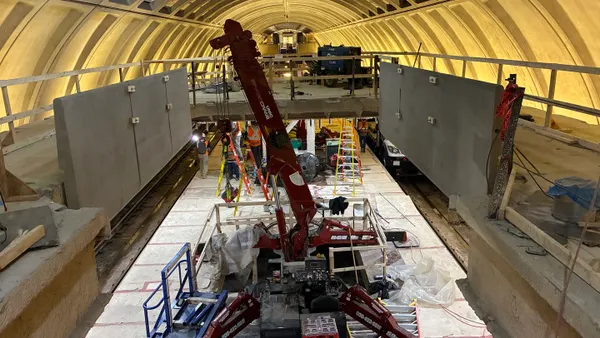
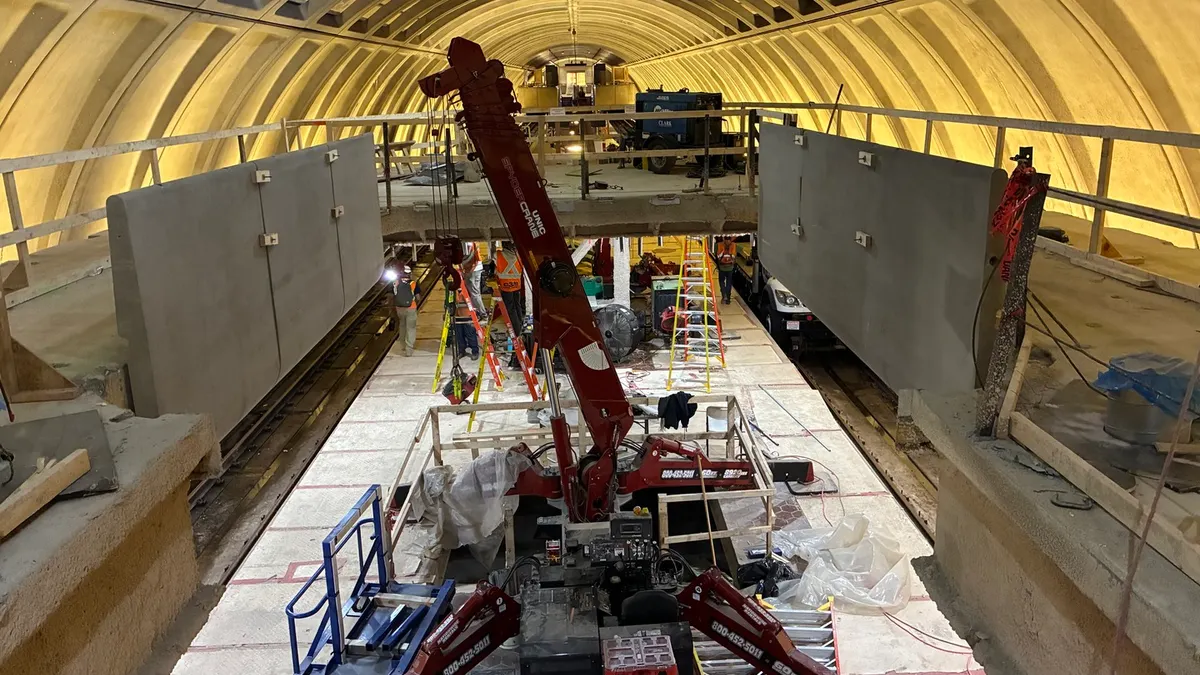
Cutting the rail power meant all machinery arrived via diesel locomotives and flatbed cars. At the Bethesda station, the team deployed ultra-compact spider cranes to operate within tight quarters, pass through narrow access corridors and maneuver inside the station’s curved vault.
Meanwhile, pouring concrete proved challenging at both sites. Record summer heat meant shifting concrete pours to 4 a.m. to keep mix temperatures below 95 degrees. At Bethesda, no direct vertical pumping route existed, so the team routed a 500-foot “slick line” pipe from an above-ground vent shaft, which it wound through access tunnels to reach the mezzanine. Clark used a custom mix that wouldn’t clog over the long distances, per the release.
Modernizations at the Grosvenor-Strathmore station are complete and work at the Bethesda station is progressing toward a 2027 completion, the contractor said.