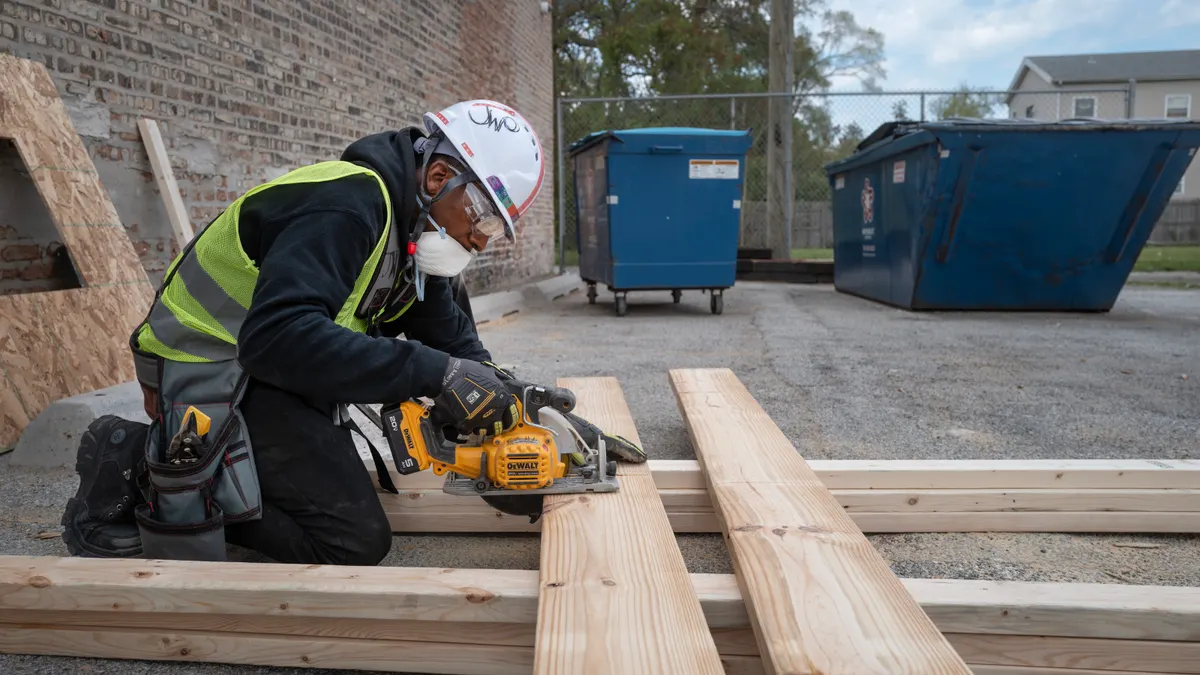
A softer construction market hasn’t made qualified workers much easier to hire.
For the first time since the COVID-19 pandemic, more contractors slashed staffing numbers than added workers over the past year, said Ken Simonson, chief economist at Associated General Contractors of America, during a Sept. 3 webinar about labor supply.
“This is the first year since we came out of the pandemic that we saw more firms reducing than increasing headcount,” said Simonson. “In other words, while some firms are adjusting to weaker demand, many contractors continue to compete for limited supply of qualified workers.”
Indeed, 87% of firms still report openings for craft workers, according to a workforce survey from AGC and the National Center for Construction Education and Research. Among those firms with openings, 88% of respondents said filling them was as difficult or harder than a year ago.
The disconnect is pushing contractors to other strategies in addition to recruitment.
“You cannot hire your way out of this situation,” said Mindy Bates, human resources director at Ace Electric, a Valdosta, Georgia-based electrical contractor, during the AGC webinar. “We got to grow it from within as well.”
Develop talent already in the building
New research points to multiskilling, or training craft workers to perform complementary tasks, as another possible solution, according to a study released by the Simplar Foundation and faculty from Arizona State University, University of Kansas and the University of North Carolina at Charlotte.
The study estimated that for every 10 multiskilled workers observed, between 14 and 17 single-trade workers would be needed to cover the same scope of work, said Brian Lines, an associate professor in the civil, environmental and architectural engineering department at the University of Kansas, during ABC’s Sept. 2 live event.
But that trust to handoff tasks needs to be properly won, said Lines.
“The definition of multiskilling we’re using here is that it’s a workforce strategy where workers are qualified to perform selected tasks safely and competently across more than one trade, craft or skill classification,” said Lines. “Now, this does not mean that individual workers are performing informal task switching. Doesn’t mean that every worker is performing every task.”
For workers, additional skills can open paths to career advancement too, said Joel Dutton, preconstruction manager at Evans General Contractors, during the ABC session. Dutton started his construction career as a welder before his employer sent him to a training program to develop new skills.
“It was there where I learned how to do pipe fitting,” said Dutton. “And from there picking up that additional skillset opened the door to me becoming a foreman and becoming a certified building inspector, and really moving into different aspects of the construction industry.”
To benefit from multiskilling, contractors are implementing different programs from the start of workers’ tenures. For example, Ace Electric brings new hires to its Ace University building for a weeklong orientation. The program covers safety and career development paths, said Bates during the AGC event. The company then sends the workers to their first project.
Holder Construction, an Atlanta-based contractor, also employs a similar workforce development approach. The firm partners with technical and community colleges on roughly five-week boot camps, said Aja Gower, Holder’s senior workforce development manager. Trade partners participate in the training and commit jobs for participants who successfully complete the program.
“We’re hopefully solving that problem five years from now,” said Gower during the AGC session. “The people entering these programs today are going to be our foremen in five years.”
These partnerships between contractors and colleges are becoming more of the norm. Alamo Colleges District in San Antonio runs a 13-week program that introduces participants to construction trades and prepares them for employment, said Sammi Morrill, the institution’s vice chancellor. The district also works directly with employers to develop training for existing workers, including programs focused on supervision and leadership.
“We customize curriculum in order to do that upskill,” said Morrill. “We have account executives that are dedicated to the employer, so that we see what your talent need is, and then we meet that need.”
Data center boom tightens the labor squeeze
Contractors with data center awards are particularly hungry for workers.
AGC reported 58% of survey respondents said data center construction increased competition for skilled workers, while 49% report increased wage pressure. Another 37% identified the availability of workers or subcontractors as their biggest challenge in pursuing or delivering those projects.
“We do have to turn down work,” said Bates. “We don’t want to overcommit ourselves.”
The scale and complexity of the builds can also create a retention challenge, said Boyd Worsham, president and CEO of the NCCER. Inexperienced workers can quickly find themselves overwhelmed on a project site worth billions of dollars.
“We take young people who have never walked on a construction job in their life, and we put them on the biggest projects in our country,” said Worsham. “Of course, they’re going to need direction and help, and we need to figure out how to provide that so that they can have this wonderful startup experience.”
Bates agreed it’s particularly challenging to retain staff on data center projects. Turnover is highest on the firm’s traveling data center teams, she added.
“We have data center work that is run by a team that is a local team, and we have data center work that is run by travel teams,” said Bates. “The travel team data center work does have the highest turnover particularly in the field and the electricians and helpers level.”