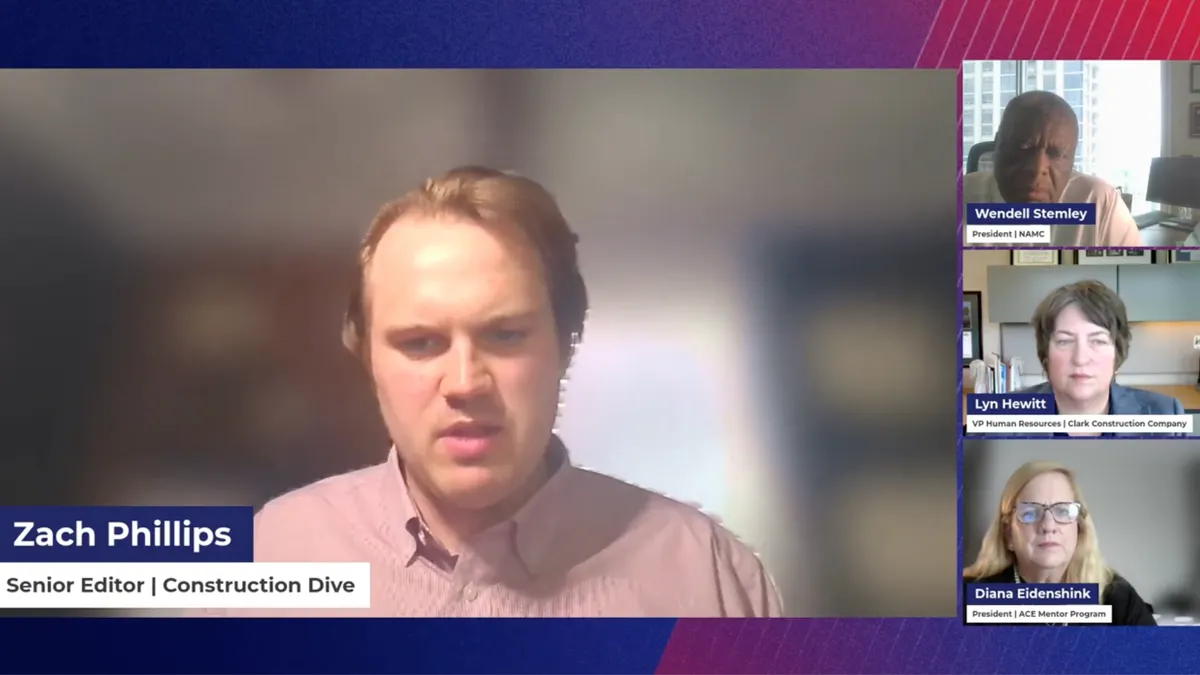
This article includes insights from Construction Dive’s recent live event, “Courting Construction: Recruiting and retaining top talent.” You can watch the full event here.
Construction firms have spent years on the lookout for workers who may already be just around the corner.
Underserved communities can help play a major role in beefing up the labor pool, but doing so may require companies to alter traditional jobsite practices, panelists said during Construction Dive’s “Courting Construction” virtual event on Aug. 26.
Takeaways from the session, moderated by Construction Dive Senior Editor Zach Phillips, center on the expansion of recruitment, which includes resolving potential barriers to entry for interested workers, panelists said.
Recruit local
Construction companies need to leave no stone unturned in order to meet staffing needs, said Lyn Hewitt, vice president of human resources at Clark Construction Co., a Detroit-based firm.
“We need more people. We need to cast a wider net,” said Hewitt. “To do this successfully, we need inclusion and we need workplaces and environments where people have safety, belonging and dignity.”
The search for workers should begin close to the construction site, said Wendell Stemley, president of the National Association of Minority Contractors. A connection with the local worker pool would simultaneously address labor needs for contractors and offer community benefits, he said.
For example, Stemley pointed to work on a multibillion-dollar project at Chicago O’Hare International Airport. The project’s start time did not align with bus schedules in the community, he said. Potential workers for the project, as a consequence, were effectively barred from applying since they could not reach the site early enough to make the shift.
“So folks were excluded from being able to pursue working on that project simply because there was not a connection of minds,” said Stemley. “We have to look at it from a real world aspect of inclusion, not just a hope and a wish.”
A similar headache happens for young families, said Hewitt. Traditional construction schedules make it difficult for parents to work on a jobsite, since the industry is usually not open to part-time work or job sharing, she said.
“To find a place for childcare dropoff at 4 a.m. to be on a job site at 6 a.m. is tough,” said Hewitt. “We have this opportunity to make changes that still allow the physical work that’s local to get done.”
Open the job site for all
The construction industry has made progress since the 1990s, but it still has a ways to go, said Diana Eidenshink, president of the ACE Mentor Program of America.
Improvements include seemingly basic aspects of working in construction, such as clean portable restrooms on job sites.
“We never thought about it until we had a brave woman come and talk to us about it,” said Eidenshink. “I would say what’s so important is that women and people throughout the industry need to share if there is something that isn’t working for them.”
Jobsite leaders also need to enforce a zero tolerance policy on inappropriate behavior, she said.
The industry could still do more on that front, added Stemley. For example, contractors should classify intimidation and discrimination as safety violations. This would create a mechanism across stakeholders to more effectively track incidents on a project.
“You don’t want to get bogged down in an EEOC debate about something that happened. For our industry, that type of behavior needs to be a safety violation,” said Stemley. “Then it would force all of the owners, all of the general contractors, all of the subs to take ownership of the action of the individual that they have on the job site.”
DEI efforts
President Donald Trump has increasingly targeted diversity efforts through executive actions during his second term.
Earlier this year, the Trump administration withheld federal funding for the $16 billion Hudson Tunnel Project between New York and New Jersey to investigate whether the project’s workforce inclusion efforts violated federal antidiscrimination laws.
But for construction firms, Hewitt said inclusion should not depend on the political pendulum at all.
“The long-term strategy is to do the right things for the right reasons,” said Hewitt. “There are companies out there who are building these safe and inclusive spaces and doing good things for the construction industry.”
Eidenshink agreed the changing environment around DEI efforts has not altered the approach at the ACE Mentor Program. The organization will continue to serve under-resourced students, she said.
“We’re going to keep doing it because the industry needs it,” said Eidenshink. “It’s not about politics, it’s about the need of the industry.”
Disclosure: DiveLive webinars are run by Informa TechTarget, the publisher behind Construction Dive. Informa TechTarget has no influence over Construction Dive’s coverage.