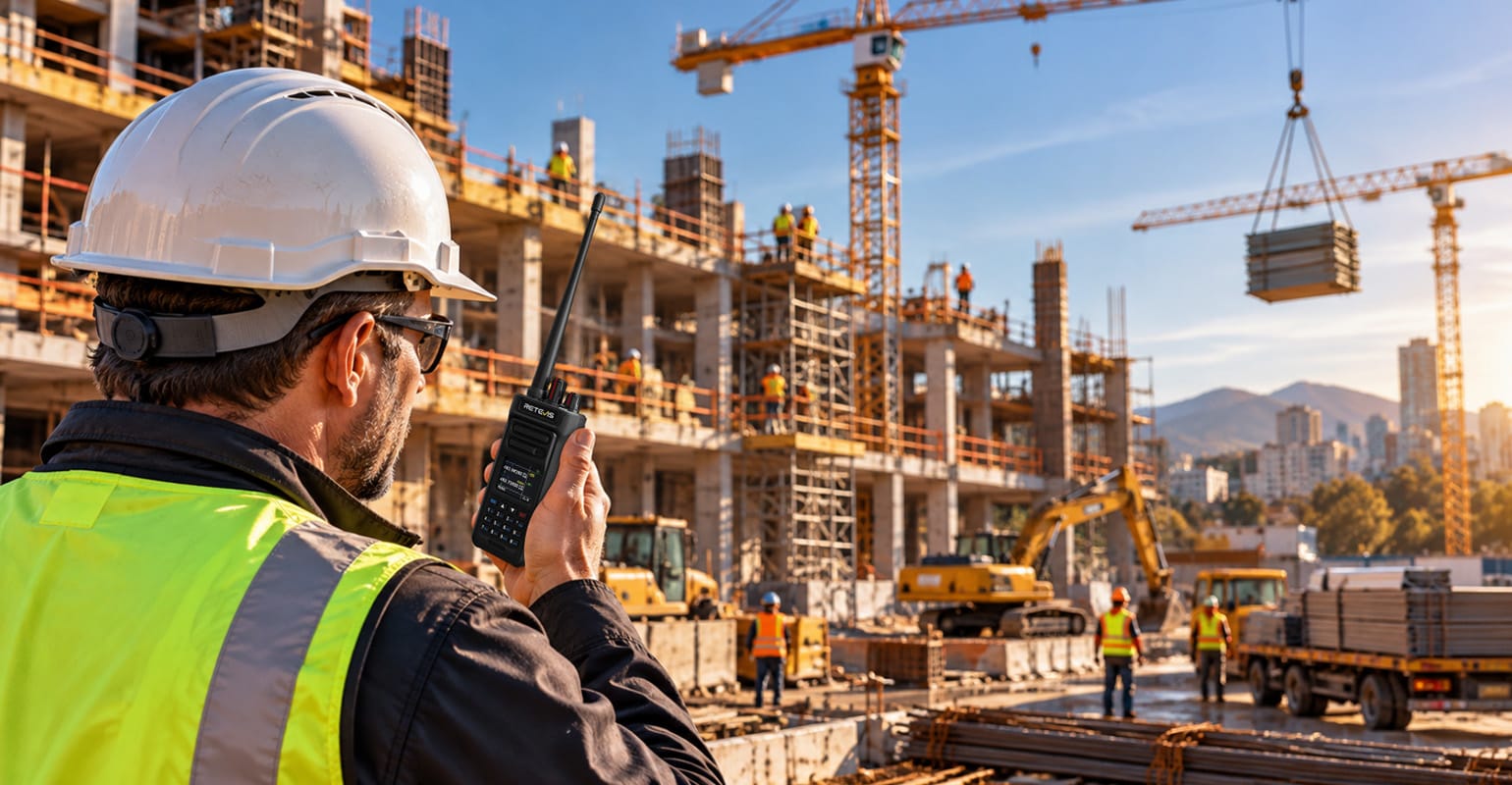
RETEVIS Expands Construction Radio Solutions for Large Jobsites
RETEVIS is expanding its construction radio solutions around one of the industry’s most persistent communication challenges: keeping teams connected across large and structurally complex jobsites.
High-rise projects, reinforced concrete structures, underground areas and large horizontal sites can all create communication gaps between crews. As workers become distributed across floors, buildings and work zones, direct handheld-to-handheld communication may not provide consistent coverage everywhere.
RETEVIS’s construction approach combines rugged two-way radios with repeater technology and site-specific communication planning to help contractors build coverage around the way their projects actually operate.
Large jobsites create real communication barriers
Advertised radio range does not tell contractors exactly how a radio will perform on an active construction site. Real-world coverage can be affected by:
- reinforced concrete and steel;
- basements and underground areas;
- multiple floors and elevation;
- distance between buildings and work zones;
- terrain and site layout; and
- radio and antenna placement.
This means a radio that performs well in an open area may behave differently inside a dense concrete structure.
RETEVIS is expanding its construction radio solutions around one of the industry’s most persistent communication challenges: keeping teams connected across large and structurally complex jobsites.
High-rise projects, reinforced concrete structures, underground areas and large horizontal sites can all create communication gaps between crews. As workers become distributed across floors, buildings and work zones, direct handheld-to-handheld communication may not provide consistent coverage everywhere.
RETEVIS’s construction approach combines rugged two-way radios with repeater technology and site-specific communication planning to help contractors build coverage around the way their projects actually operate.
Large jobsites create real communication barriers
Advertised radio range does not tell contractors exactly how a radio will perform on an active construction site. Real-world coverage can be affected by:
- reinforced concrete and steel;
- basements and underground areas;
- multiple floors and elevation;
- distance between buildings and work zones;
- terrain and site layout; and
- radio and antenna placement.
This means a radio that performs well in an open area may behave differently inside a dense concrete structure.Instead of asking only, “How many miles does this radio reach?”, RETEVIS recommends contractors begin with a different question:
Where does the team need to communicate, and what stands between them?
Map the jobsite before choosing the system
A practical construction communication plan can begin by mapping four factors.
- People Identify where supervisors, crane teams, material crews, safety personnel and subcontractors work.
- Barriers Locate concrete cores, underground levels, steel structures and other areas likely to affect radio coverage.
- Communication groups Determine which teams need direct communication and which messages need to reach multiple crews.
- Coverage gaps Identify areas where direct radio-to-radio communication becomes inconsistent.
This creates a communication map based on the project rather than on an advertised product specification.
When handheld radios aren’t enough
Rugged handheld two-way radios can provide the foundation for everyday construction communication. But on larger projects, distance and structural barriers may require another layer of coverage.
A two-way radio repeater receives a transmission and retransmits it from another location, helping extend the communication path beyond straightforward handheld-to-handheld operation.
The architecture becomes:
Handheld radio → Repeater → Handheld radio
RETEVIS’s construction portfolio combines professional handheld radios with repeater options, including portable repeater solutions designed to help extend communication across larger operating areas.
This allows contractors to approach communication as a scalable system rather than simply purchasing more individual radios.
From radio product to construction communication solution
The shift is important because different areas of the same construction project can have very different communication requirements.
Ground crews may need rugged everyday communication.
Crane operators need dependable contact with spotters.
Safety teams may need rapid access to multiple work groups.
Workers behind concrete or underground may need extended coverage.
A communication system can account for these differences.
“Reliable coverage starts with understanding the jobsite—not simply choosing the radio with the largest range number,” said MR ZHAO of RETEVIS product director.
For RETEVIS, that reflects a broader evolution from providing two-way radio products toward solving real communication problems through people, environment, coverage and solution design.
16 years of reliable connections
The expanded construction radio solution comes as RETEVIS celebrates 16 Years of Reliable Connections in 2026.
The anniversary reflects 16 years of learning how communication needs change across different users and operating environments—from straightforward team coordination to rugged industrial communication and wider-area coverage. Large jobsites may be different from one project to the next.
But the expectation does not change:
the right person needs to reach the right team when communication matters.
Different World. Same Connection. Always Reliable.
RETEVIS is a global two-way radio brand, providing reliable communication products and solutions for Outdoor Adventures & Family Leisure,Business & Daily Operations,Heavy Industry & Extreme Environments,Professional Communication & Solutions and Amateur Radio & Technical Exploration.