This article includes insights from Construction Dive’s recent live event, “Courting Construction: Recruiting and retaining top talent.” You can watch the full event here.
The data center boom has given contractors a good problem to have: more work than workers.
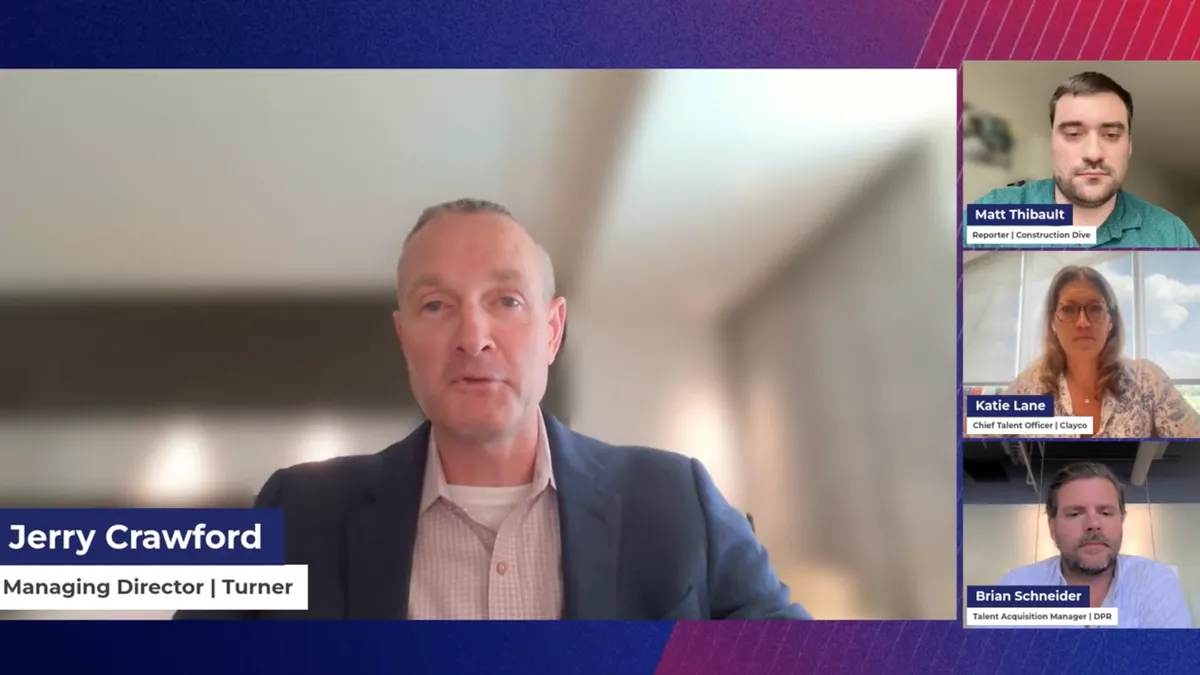
As contractors win massive awards for the artificial intelligence buildout, builders are looking for ways to find and keep enough workers on these jobsites, panelists said during Construction Dive’s “Courting Construction” virtual event on Aug. 26. Moderated by Construction Dive Reporter Matt Thibault, the conversation’s focus ranged from ways to expand the potential labor pool and upskilling programs for existing employees.
Build your workforce
The scale of data center work has magnified the need for virtually every role on the jobsite, said Jerry Crawford, managing director at Turner Construction.
“When we talk about data center work, there’s an extraordinary amount of work that’s out there right now, and it’s creating extraordinary opportunities for people,” said Crawford. “That’s electricians, that’s pipe fitters, plumbers, welders, safety professionals, foremen, general superintendents, project managers. We need to change the talk to really highlight that.”
Turner is turning to a familiar strategy to fill those roles: Start local.
“We’re not just looking for travelers that are going to come in and build one project and then leave and go build a project somewhere else around the country,” said Crawford. “We’re looking for local pipeline, local talent.”
Contractors should also focus on the development of their own employees, said Katie Lane, chief talent officer at Clayco.
“Part of the challenge with some of these large hyperscale projects is we’ve got people working on them who have never done this before at this scale,” said Lane. “And so we are needing to re-educate internally on these different types of projects that we’re working on.”
Upskill programs
That internal re-education revolves around Clayco’s “re-recruiting” tactic, said Lane. The strategy emphasizes reengaging workers already with the company, she said.
“Not that they’re disengaged, but we’re continuously looking at what are ways that we can make sure we’re helping our people to be successful,” said Lane. Though money may be a reason to leave, other factors may encourage retention.
“Nobody is going to win retention on compensation alone,” she said.
For Clayco, the effort starts with an extension of onboarding support through an employee’s first six months to a year. The contractor also revised its incentive programs for larger projects. This includes travel rotations and student loan repayment assistance, according to Lane.
All these strategies center on ways to expand the labor pool, said Crawford.
“Yes, there is a workforce shortage that’s out there and a workforce challenge, but it’s also a tremendous workforce opportunity,” said Crawford. “There’s significant work all across the country, border to border, coast to coast, and it’s happening everywhere. It’s happening simultaneously. It’s an enormous amount of work that we have to build, but it also takes an enormous amount of skilled people to build it.”
A mobile workforce
For remote jobs, however, panelists noted a local recruiting effort may only fill a fraction of the worksite needs. On these jobs, a mobile workforce is becoming as important.
DPR Construction, for example, began to take a mobile workforce strategy more seriously around 2023, said Brian Schneider, talent acquisition manager at DPR. The artificial intelligence buildout surge in 2024 added to the urgency.
“We want to make this process as easy as possible on our people because it is challenging work,” said Schneider. “Traveling can be difficult.”
Since every worker does not have the means to relocate easily, DPR offers benefits to make the transition easier. These offers can include living allowances or per diems, project incentives, mobilization bonuses, travel stipends and a salary increase, said Schneider.
The thought is to promote overall employee well-being, said Lane.
“It’s not just about compensation anymore, it’s about taking care of people, giving them opportunities,” said Lane. “Historically, it was here’s compensation, here’s benefits, welcome to the club. Now, we’re having to solve for many other aspects that might be sweetening the pot for people.”
Disclosure: DiveLive webinars are run by Informa TechTarget, the publisher behind Construction Dive. Informa TechTarget has no influence over Construction Dive’s coverage.