This article includes insights from Construction Dive’s recent live event, “Courting Construction: Recruiting and retaining top talent.” You can watch the full event here.
Long hours and hard work have been traditional badges of honor in construction. Generation Z, however, doesn’t plan to play by the old rules.
Young workers see plenty to like in the construction industry and also room for innovation, Gen Z panelists said in a conversation moderated by Construction Dive Senior Editor Zach Phillips during the “Courting Construction” virtual event Wednesday. For contractors, the arrival and retainment of these young go-getters will be increasingly important as firms face a looming generational handoff.
Sell the career
Construction firms looking to recruit Gen Z members should stress the advantages the industry can offer, particularly the opportunity to climb the ladder quickly.
Retirements among longtime construction leaders will create openings for the younger cohort to learn the business, said Fulton Cure, a consultant at Baltimore-based Well Built Consulting. For young employees getting their foot in the industry, the turnover presents a chance to move up the ranks relatively fast.
“We’re seeing it all over the place that there are so many companies that have these amazing senior leaders who have been there for 15, 20, 30 years,” said Cure. “Those people are retiring in the next 10 to 15 years, and somebody’s going to have to fill their spot.”
Another selling point is the ability to see what their work produces. In other words, firms can sell job fulfillment in their recruitment efforts.
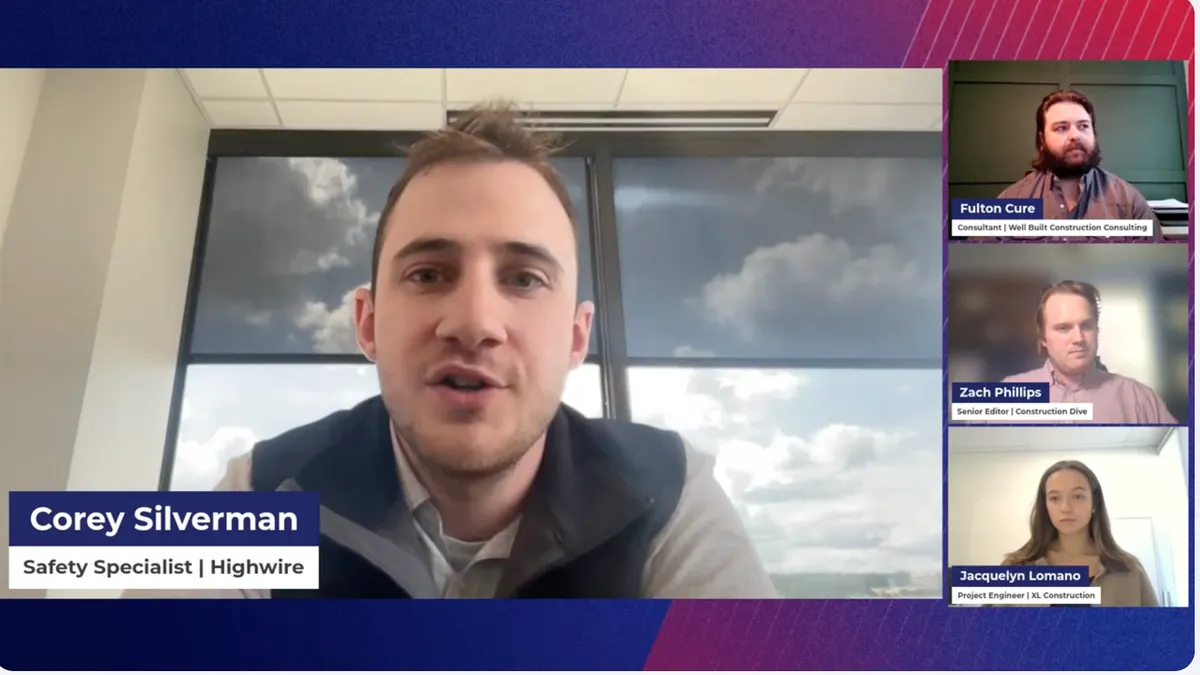
“I think working in construction can bring a lot of pride and fulfillment that you don’t get in other industries,” said Corey Silverman, safety specialist at Highwire, a Burlington, Massachusetts-based software development company. “I know that when I was part of a team that finished a project or we had a topping out party, it was just really cool to be able to say, ‘Wow, I was a part of that massive building being built.’”
Cure pointed to a similar experience.
“I drove my daughter down the street and I’m like, ‘Dad built those apartments right there,” said Cure. “It’s so awesome when all these people work together to accomplish something.”
Those opportunities are appealing selling points as many members of Gen Z reconsider the four-year college degree path, said Cure. Young people have reasons to weigh alternatives to college, added Silverman, especially as a degree can leave graduates with debt and uncertain employment prospects.
Professors on college campuses are aware of this uncertainty as well, said Jacquelyn Lomano, project engineer at Milpitas, California-based XL Construction. Lomano, who started her role at XL Construction about two weeks before the panel, graduated from Cal Poly San Luis Obispo in June with a construction management degree. She said some of her peers in other fields struggled to find jobs.
“Coming out of college, when people were looking for their jobs, I had teachers tell me when I was studying structural engineering, that AI would take my job,” said Lomano. “You could look around, it’s been happening to a lot of people, and a lot of my peers couldn’t find jobs right when they graduated.”
Nevertheless, many construction companies still need workers across a range of positions on the jobsite.
“I think that’s where the construction industry comes in at a different angle, where they need people, they want people to be a part of this industry,” said Lomano. “We’re in a good place in the economy right now, and I would advertise that as the number one thing.”
New badges of honor
But getting young workers through the door is half of the challenge. The other hurdle is ensuring these young workers don’t walk out again.
“I think Gen Z as a whole seems to really care about trying to maintain work-life balance,” said Silverman. “It’s something the industry needs to think about and be aware of as they try to attract and retain top Gen Z talent.”
For Silverman, this retainment starts with understanding the Gen Z approach to work-life balance. Though projects often demand long schedules, younger workers may be less willing to accept that if they think alternative approaches could help work get done sooner, said Cure.
“We’re not anti hard work. We’re not anti doing the thing that has to be done,” said Cure. “We’re just also very in tune to say there’s got to be a better way to do it.”
Knowledge transfer
To get the best out of Gen Z, experienced workers will be challenged with sharing decades of wisdom before their retirement. A successful knowledge transfer will require effort, and more importantly humility, said Cure.
“It’s all about humility, it really is,” said Cure. “It’s about humility from both sides of the coin.”
Early in his own career, Silverman felt pressure to prove he was not an inexperienced newbie. The big switch happened, however, when Silverman owned his inexperience and sought help from experienced workers directly.
“It was when I started to say, ‘I don’t know what this is, can you teach me this?’ Or ask the superintendent, ‘Can I come on this walk with you and you tell me what these things are?’ That’s when I really started to learn,” said Silverman. “No one is expecting you to come out of college with all that knowledge.”
Lomano also experienced the learning curve in her first few weeks at XL Construction. Despite graduating with a construction management degree, her first meetings on the job taught her how much knowledge comes through first-hand experience.
“My mentor told me maybe a year or couple of months, but eventually, as time goes on, you’ll get it,” said Lomano.
Disclosure: DiveLive webinars are run by Informa TechTarget, the publisher behind Construction Dive. Informa TechTarget has no influence over Construction Dive’s coverage