WSP remains full steam ahead as it continues to leverage the tools it’s gathered, both on the artificial intelligence and M&A fronts, to drive its growth, CEO Alexandre L’Heureux told investors during the firm’s Q1 earnings call on Thursday.
Both have been key for the company as of late, L’Heureux said. The contractor is seeing a deluge of opportunities related to AI, including data center and power generation projects, with the latter making up approximately one third of its U.S. revenues, according to L’Heureux.
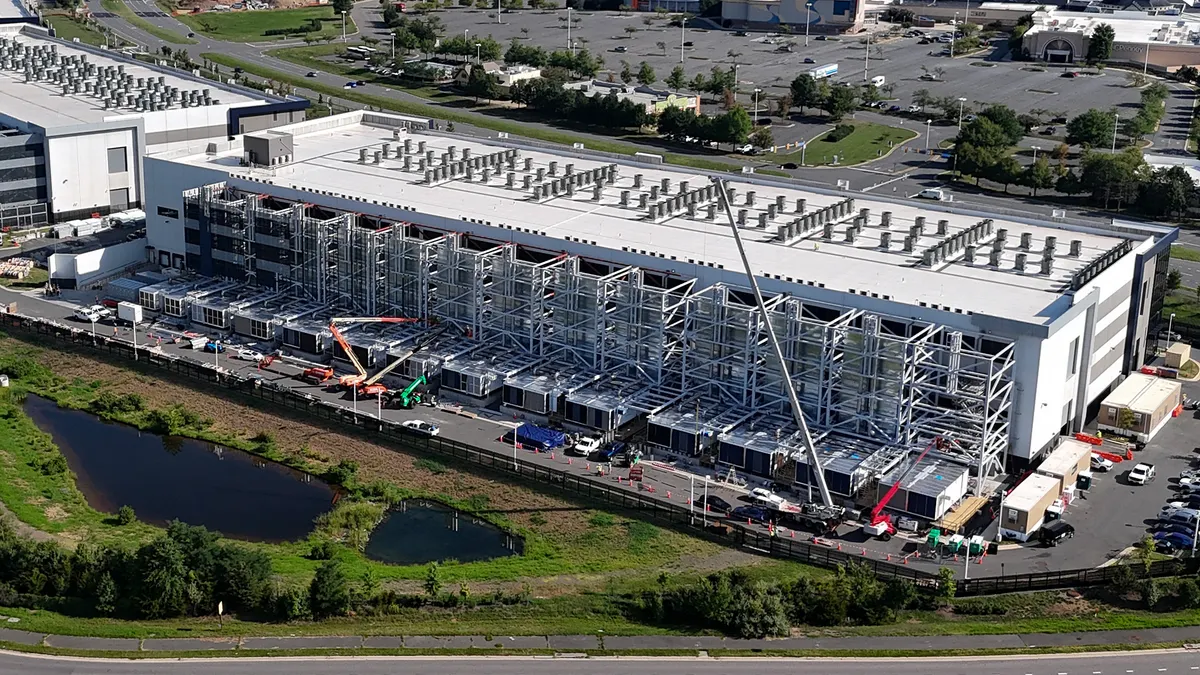
Power generation projects are gaining momentum as the data center surge forces owners and municipalities to reckon with the pressure that the facilities can put on local power grids. Amid legislation and community pushback, power constraints are among the leading causes of data center delays.
WSP’s own work in power generation, L’Heureux said, has been buttressed by the company’s acquisition of power infrastructure firm TRC in December.
“We are very proud to have completed the strategic and timely acquisition of TRC, and our power and energy service offering is now second to none,” L’Heureux said.
To that end, M&A activity has been a key part of WSP’s growth strategy. Last year, the company acquired life sciences consulting firm Lexica in June and U.K.-based engineering consultancy Ricardo in October.
In response to an analyst question on future M&A plans, L’Heureux pointed to that history while also acknowledging that the company has deployed approximately $6 billion to $7 billion Canadian dollars ($4.4 billion to $5.1 billion) over the past two years on the M&A front.
“So I think it's absolutely normal that we are at the top end of our range right now from a leverage point of view. Having said all that, I always and continue to have informal and formal discussion with our pipeline of opportunities. That remains very much at the center of our strategy and we intend to benefit from the current environment,” L’Heureux said.
The AI advantage
In addition to M&A activity, WSP’s AI usage was also a topic of discussion for L’Heureux. The firm had recently wrapped up its Global Technical Excellence Conference, held every two years, where more than 400 WSP employees gathered to discuss how the company was using AI across the organization. These use cases, L’Heureux said, were primarily focused on improving quality and decision making while mitigating risk.
He specifically called out the company’s use of Nature Vista, WSP’s environmental management platform, which leverages AI and other tech to help give asset owners a view of their project’s environmental impacts.
The call outs came on the heels of WSP’s fourth quarter and full-year earnings call in February, where L’Heureux warned investors not to give in to what he called “AI hysteria” over the tech’s possibility of replacing the services WSP provides.
“In summary, by staying client-focused, investing in our people and partnering smartly, we are harnessing AI to drive growth, augment our technical excellence and deliver value for our client,” L’Heureux said on Thursday’s call.
To that end, one analyst asked L’Heureux if there were any metrics that WSP could point to to show how much AI usage has increased in the past one to two years, which L’Heureux said the company didn’t track, but wagered it would be a large number of employees.
“I can tell you that this year, we have rolled out AI tools to more than 30,000 of our 80,000 employees. But I would tell you, and I would venture that the use of AI tools within our business is way more than 30,000 employees,” L’Heureux said.
WSP is far from alone in working to establish AI in its workflows. Contractors of all shapes and sizes are using the tech, which is far removed from its infancy, across both front office and back office functions, on the jobsite and in the meeting room.
By the numbers
For the first quarter of 2026, WSP generated approximately CA$4.55 billion in revenue, a 4% increase year-over-year from CA$4.39 billion in Q1 2025. It also reported flat profits, recording CA$144.1 million for both Q1 2026 and 2025.
WSP’s backlog was one of the brightest spots for the firm, which reached a record level of CA$19.7 billion. That’s an approximately 19% year-over-year increase from 2025’s CA$16.6 billion.
The contractor has benefited from the AI boom. Some of the company’s key sectors, such as power and energy, data centers, mining and digital solutions, are all experiencing elevated growth, L’Heureux told investors. Those sectors represent about one third of WSP’s net revenues.
“Our record backlog and strong pipeline of opportunities continue to underscore the resilience of our globally diversified platform and we are investing in talent and technology to deliver in a high-demand environment,” L’Heureux said.