Border infrastructure work and data center site preparation have grown to a larger share of Granite Construction’s business, with federal contracts trending toward 15% of revenue, the company said on its first quarter earnings call Thursday. Data center projects could account for another 10%.
Those increases, in part, led the Watsonville, California-based contractor to up its 2026 revenue guidance. It said it expected an additional $200 million in revenue from its border work in Southern Texas, with its recent acquisition of Kenny Seng Construction in Utah contributing another $100 million. Granite said it would continue to look for more acquisition targets moving forward.
The firm added to its backlog as well, despite the cancellation of an approximately $300 million highway project in California. Granite President and CEO Kyle Larkin said the withdrawal of the project was rare and that the firm’s overall backlog increase “reflects a bidding environment that remains robust at the federal, state and local and private levels.”
Data centers and border work
Of its $7.2 billion in backlog at the end of the first quarter, approximately $640 million comes from tactical infrastructure projects for U.S. Customs and Border Protection. In 2025, Granite grabbed the first border wall contract of President Donald Trump’s second term, then added a $495 million project for tactical infrastructure work near Laredo, Texas, in 2026.
That second award amount was larger than the smaller work packages Granite has pursued in recent years in order to limit the outsized risk that comes with multibillion-dollar, yearslong megaprojects. However, Larkin said the fast pace of the Laredo work has given better visibility into the contractor’s overall risk.
“That project burns over around 14 months and so we expect to be right around 40% complete” by the end of 2026, Larkin said.
He broke the risk of the border work down into three categories: schedule, the remote jobsite and subcontractor and supplier uncertainty.
Larkin said the quicker pace has mitigated schedule concerns. Granite has also deployed resources in the region to counter its isolated location. Finally, the builder has been choosy with its suppliers.
“You think about a $40 billion program along the border, there's a lot of subcontractors and suppliers that are participating in that at levels that they probably typically don't participate in, and so there always is some risk,” Larkin said. “So we're being very selective about the partners that we have on this project.”
Indeed, Larkin said the firm hoped to gain more border work in the region during future lettings anticipated for June and July.
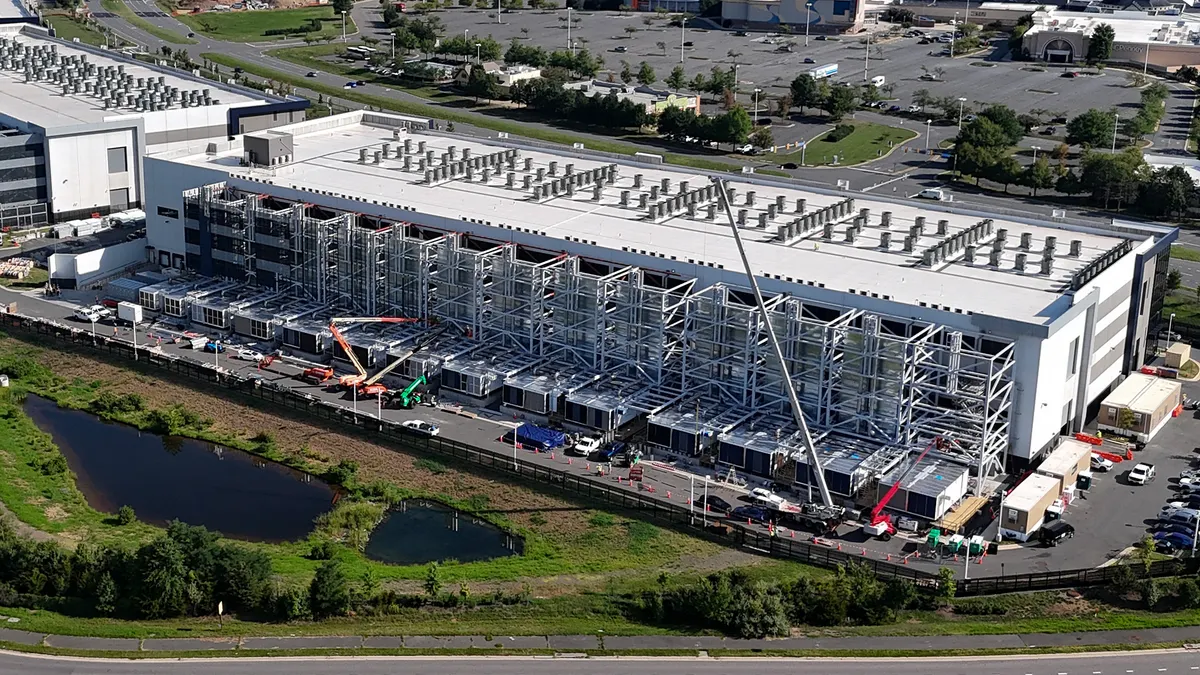
On data centers, Granite has been busy taking a picks-and-shovels approach to the building boom, carving out site infrastructure and selling materials for roads before structures go up.
“We're successfully delivering and we are supplying materials to projects in Washington, Oregon, Nevada, Arizona, Louisiana and Mississippi,” Larkin said. “We're really able to tackle it from a civil component, a water component … and/or just materials.”
Asked by analysts about the rise in fuel prices due to the war in Iran, Larkin said Granite hadn’t seen significant cost increases.
“The energy surcharge we put in place after Q1 in 2021, and our materials business specifically, that’s really provided us some good protection around just cost increases,” Larkin said.
By the numbers
Granite reported a wider net loss of $41.7 million for the first quarter of 2026, compared to $33.7 million during the same period in 2025, on revenue of $912.5 million, a 30% increase from a year ago.
Backlog, which the company refers to as committed and awarded projects, or CAP, grew by $200 million sequentially from the fourth quarter to $7.2 billion. On a year-over-year basis, that represented a $1.4 billion increase, or 24%, from the first quarter of 2025. The firm attributed $1.3 billion of its backlog to federal contracts.
The firm also raised its full-year revenue guidance for 2026, increasing its projected range to $5.2 billion to $5.4 billion. Previously, it had anticipated $4.9 billion to $5.1 billion in revenue for the year.