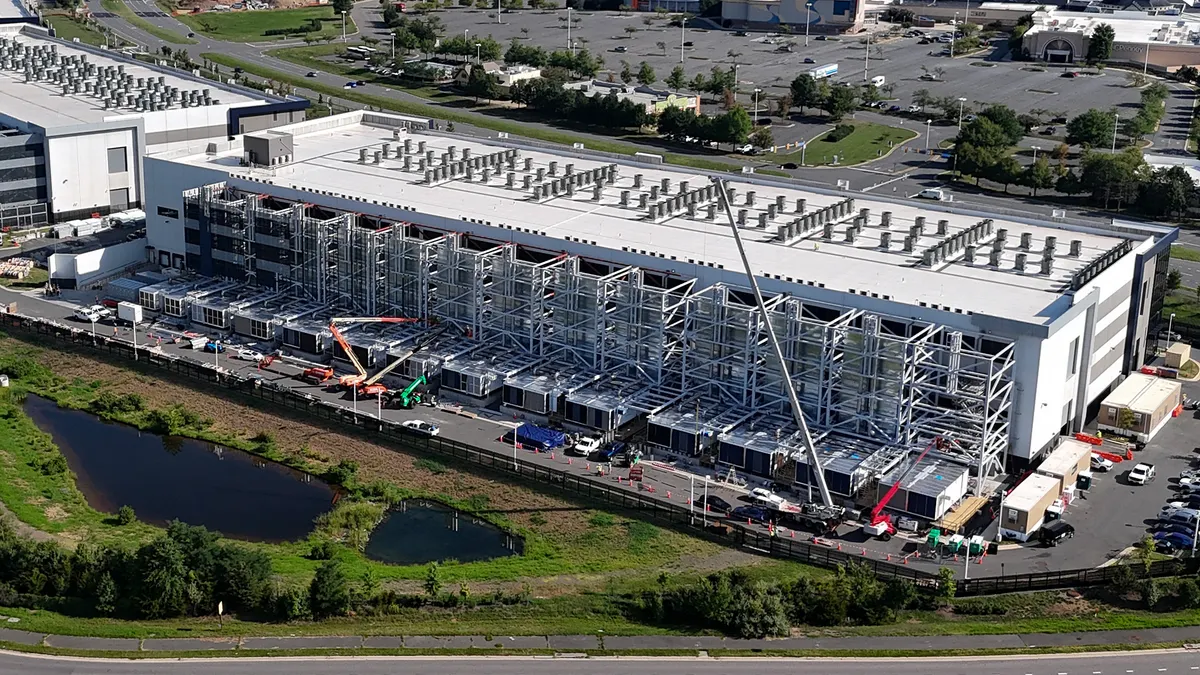
For months, data centers have been a sole bright spot in a weak construction market. Now, developers chasing gigawatt data centers have found many projects are stalling before construction crews ever break ground.
The reasons span from a lack of sufficient power for the electric-hungry behemoths to public opposition and, in an increasing number of regions, legislation aimed at slowing the roll of the data center boom.
Access to power is one key hurdle. The size and scale of these facilities has grown rapidly. A few years ago, a 100-megawatt lease would have been considered a massive build. Today, projects over 1,000 megawatts are setting the benchmark, said David Guarino, head of global data center and tower research at Green Street, a Newport, California-based commercial real estate data provider.
The projects’ need for huge amounts of power has created obstacles to build and increased prices. Meanwhile, communities and political groups have opposed the projects, leading to delays or abandonments.
Political resistance to construction
Indeed, data center project cancellations more than quadrupled to 25 in 2025 from six in 2024. In 2023, there were two such cancellations. That’s according to a recent research note from Justin Hauke, senior research analyst at financial services company Baird.
For those reasons, panelists at this year’s New York Build conference said a community benefits plan is quickly becoming a must-have for proposed data center builds to survive scrutiny. “The number one concern we have in the market right now is public sentiment,” said Rob LoBuono, principal at San Francisco-based design firm Gensler, during a panel discussion on the topic.
“What looks viable on paper usually breaks down on power, permitting or labor, and sometimes all three.”

Brennan Church
Director of engineering, procurement and construction at data center developer Hut 8
At least 188 local opposition groups now operate across 40 states, according to Baird. And some states have already proposed construction moratorium laws on the facilities.
In Maine, a bill which would block builds over 20 megawatts until late 2027 has landed on Gov. Janet Mills’ desk, though she has yet to sign it into law. In Virginia, developers shelved a data center campus project planned near the Manassas National Battlefield. Similar data center construction ban proposals are under consideration in more than a dozen states, according to Baird.
With critics increasingly voicing concerns that the builds are causing spikes in consumer’s electric bills, developers have taken action to respond. For example, hyperscalers recently pledged to “build, bring, or buy all of the energy” needed for data centers, though many experts are skeptical the pledge will yield ratepayer relief.
On the ground
If and when a data center project muscles its way through the legal front, work doesn't get easier on the ground.
“The biggest bottleneck we are seeing is on long-lead electrical equipment. Switchgear, transformers and generators are all running extended lead times, with medium voltage switchgear often at 40 to 60-plus weeks,” said Brennan Church, director of engineering, procurement and construction at Hut 8, a Miami-based data center developer. “A shell can be completed and mechanically roughed in, but if the gear isn’t onsite, you’re not energizing.”
In-demand equipment, such as switchgear and transformers, continues to face delays that lengthen project completion timelines. The same problem plagued the advanced manufacturing boom in 2023, which strained supply chains for steel and switchgear.
Unlike advanced manufacturing builds, however, data centers require an additional round of coordination around power access. That has become as important to project timelines as execution on the jobsite.
“This is a common challenge across the industry right now. A site can look perfect on paper, with strong land and fiber access, but if the utility cannot commit to a firm delivery timeline, the project stalls,” said Church. “What looks viable on paper usually breaks down on power, permitting or labor, and sometimes all three.”
For that reason, contractors prioritize projects where power is already secured. Fewer firms are willing to mobilize a large crew only to sit idle waiting for energization, said Church. He added projects that cannot demonstrate that level of readiness are finding it harder to attract top-tier partners.
But even if it takes a long time for the equipment to make its way to contractors’ hands, orders are still pouring in.
“Lease sizes are getting significantly larger, driven by both neocloud and hyperscalers,” said Guarino. “I wouldn’t say one is leading the charge, but both groups are collectively pushing forward.”