

In 2019, the Hard Rock Hotel under construction in New Orleans partially collapsed, killing three and injuring dozens more. Norma Jean Mattei said the event happened practically in her backyard.
At the time, she said the local media grew to know her well, and for good reason. Mattei served as president of the American Society of Civil Engineers in 2017. Today, she is professor emeritus at the University of New Orleans.
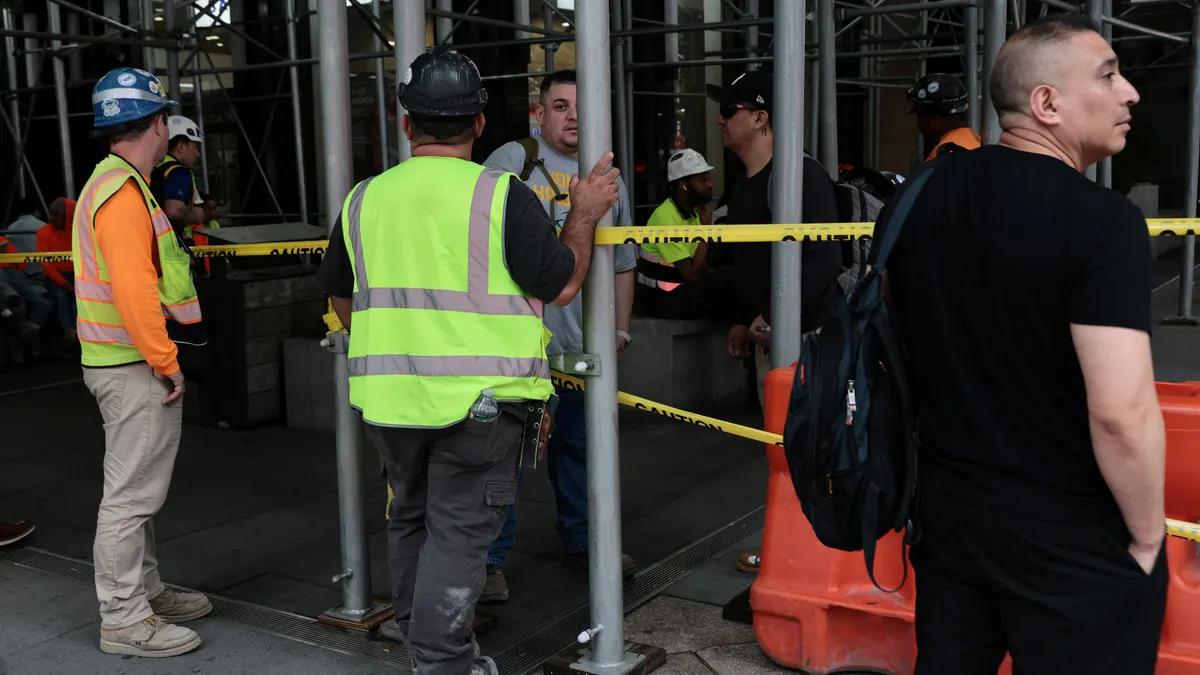
In both the Hard Rock collapse and the case of East 42nd Street’s failing columns in Manhattan, haunting video from inside the jobsites showed the beginnings of structural concerns. The New York City office-to-apartment conversion project was evacuated with no injuries or deaths.
Here, Mattei talks with Construction Dive about assessing the dangers of a structure, the nature of the work contributing to the columns’ failure in New York and where construction pros should turn with concerns.
Editor’s note: The following has been edited for brevity and clarity.
CONSTRUCTION DIVE: There were thankfully no injuries or fatalities in this case. Beyond that, what are the broader implications of this structural failure?
NORMA JEAN MATTEI: We are going to start hearing about more of this, unfortunately, because we do have a housing shortage.
Office buildings may more often be thought about by their owners as potential reuse. When you're taking an older building and renovating it for another purpose, especially if you're adding to it or modifying it significantly, there's always a risk associated with it.
So you think the project type may have contributed to the failure?
More than likely. In this instance, you have an older building. Thank goodness, it doesn't appear at all related to its foundation. They probably brought in a good team and looked at the foundation of the structure and looked at the capacity of the structure in its condition to be renovated for this new use.

And the problem with a structure that is older is, it has aged. It has degraded. It may not have been maintained. Even if it has, with high-rises, you can't see the skeleton, you can't see the framing that's actually holding the building up. And now you are going to take it and hold something up differently.
In taking things apart, potential issues may appear because of either design errors or construction errors that didn't actually come into play during the lifetime of the original building, per se, until these changes.
How will this impact other builders or developers working on similar projects in New York City?
Let’s look at Surfside as an example.
Miami-Dade County saw that they had all of these older high rise condominiums, all of the same vintage, hitting 40 years old. Some of them had had issues with poor construction or poor maintenance, so they had put into place legislation where as soon as a condominium hit 40 years old, they had to have a licensed engineer do a structural assessment.
If Manhattan's going to see more and more conversions, if they're starting to see something that is systemic, they’re going to want to look at how to mitigate this risk. Permitting's all about oversight. You have to enforce the regulations. Because if, if people know that you've got regulations in place, but you don't enforce them, well, why have the regulations?
The video from inside was reminiscent of the 2019 Hard Rock collapse in New Orleans. Do there appear to be similarities between them to you?
That was a catastrophic failure.
It was a series of cascading failures that brought that building down. There was that video of a worker, and he was saying in Spanish to someone, “Look at this.”
And so think about if you have a subcontractor who has an employee, wouldn't you want that employee to tell the foreman, and then the foreman to then tell the superintendent so they could have avoided this because there was evidence that there were issues?
But if your workforce is non-English speaking and perhaps illegal, are they going to then feel empowered to tell someone else up the chain about this issue? And I believe that that did play a part in the Hard Rock failure.
It sure sounds like the New York failure was very localized. They caught it before it became catastrophic. It might have just been a local failure, and that was as far as it was going to go.
With failing columns and sagging floors, is it realistic that the project will be fixed and continue upward? Or will some of it need to come down?
It depends: What is the problem? It’s an older building, it may have not been maintained well, they may have had corrosion or it might be a localized construction failure. But if it's a design issue that is systemic, then it's a bigger problem.
You can mitigate anything. Once they figure out what that issue is, then they can decide if it's a localized maintenance or construction error, or even a design flaw that was very localized. If it’s part of the framing system, you can easily repair that. If the maintenance issues have caused issues all over, you can deal with that.
You just have to be careful, and that means taking time to look at the underlying causes. If it's a construction error that you didn’t know about, well, hey, you may have others.