Dive Brief:
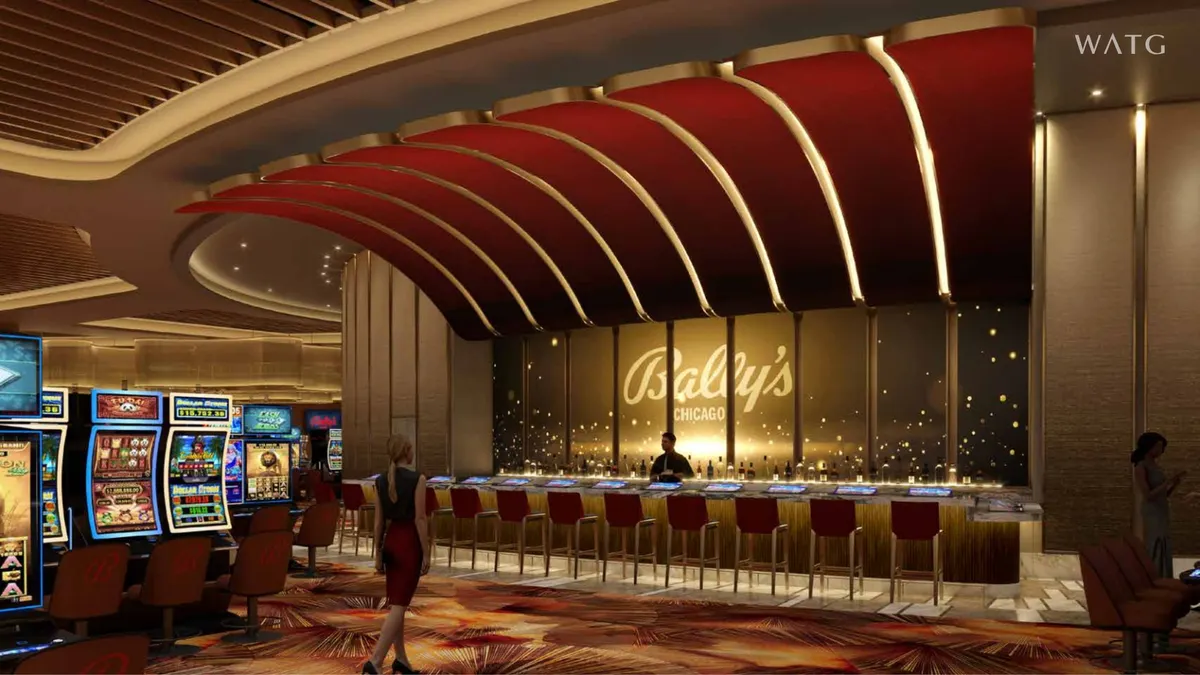
- The owner of a $1.7 billion casino development in Chicago has slowed down construction on the complex as it wrestles with the city’s legalization of video gambling terminals, the Chicago Tribune reported.
- Bally’s Chicago, the casino owner, informed the Chicago Community Builders Collective, the construction team responsible for building the development, that it was “resetting the pace of construction,” Bally’s said in a statement shared with Construction Dive.
- At the crux of Bally’s gripes is the recent approval of video gambling terminals in the Windy City, which Bally’s claims violate its 2022 Host Community Agreement with the city. The city approved the terminals last fall, and officials included revenue from the terminals in Chicago’s 2026 budget, per the Tribune.
Dive Insight:
The affected construction activities include a hotel, events center and restaurants, per the Tribune. As a result of the scaleback, 1,500 union construction workers have been impacted, per Bally’s statement.
Bally’s first won approval in 2025 for the 30-acre redevelopment along the Chicago River, the former site of the Tribune’s newspaper printing operation.
In addition, the CCBC — a joint venture of Gilbane Building and a host of Chicagoland firms — topped out the casino, the cornerstone of the Bally’s project, in April.
Bally’s said it still plans to hold its initial timelines for casino construction and honor the deal it made with the city. But other non-gaming amenities, including a hotel tower, several restaurants and an events center are now on hold, according to the Tribune.
“Note that initial opening of the permanent Casino remains unchanged for early 2027 and Bally’s Chicago intends to fully honor its commitments under the Host Community Agreement,” the company said in the statement.
The CCBC and the mayor’s office did not respond to requests for comment. Gilbane Building deferred inquiries on the subject to Bally’s.
Although the larger development now faces uncertainty, other flagship projects in the Windy City have progressed, such as the $5.7 billion Red Line transit extension and a new $750 million stadium for the Chicago Fire, the city’s professional men’s soccer team.