

What browser are you using?
That simple question marked a clear delineation between generations on a recent project I was a part of.
When asked, members of Generation Z responded instantly and confidently. Their more senior counterparts sometimes didn’t know the answer right away, needing to look around their computer or even describe the icon they clicked on to access the internet.
That’s emblematic of a skillset that comes practically baked in with Gen Z: ease and instant familiarity with technology and software, even with new apps, due to growing up with devices at our fingertips at an early age.
By the same token, zoomers told me they realize their instant knowledge of a web browser pales in comparison to their senior colleagues’ recognition of, and solutions for, issues on the jobsite. Just as Gen Z knows tech, their veteran colleagues have an invaluable wealth of knowledge on building.
Luckily, Gen Z sources I spoke to for this column told me that their employers realize their skillset and have started to use that tech intuition as a way of reverse mentoring and countering the brain drain that can occur as those vets approach retirement.
Construction as a luddite industry
Implementation of technology in construction has a reputation for lagging, especially at the field level, said Corey Silverman, safety specialist at a Burlington, Massachusetts-based software development company Highwire, and a member of Generation Z.
Thankfully, that’s changing, Silverman said.
“I've been involved in multiple large scale technology implementations at the field level, and they were difficult, but it was rewarding working through some of these really tough challenges and improving these outdated and inefficient processes that have been in place for so long,” he said. Silverman’s comments came during Construction Dive’s virtual event on Aug. 26 about recruiting and retention in the industry.
Even as that adoption progresses, there’s still room for improvement.
Alondra Mendoza, a zoomer and assistant superintendent at Boston-based Suffolk Construction, said on one project she helped teach common jobsite apps — such as Procore and Bluebeam — to a senior superintendent who worked purely off paper, pencil and brain power.
That helped solve a big problem in relying on that one person’s vital experience.
“The moment that that person who has all the information in their head steps off [the jobsite], that's it. There is no documentation of it,” Mendoza said. “And that is one of the biggest discrepancies I have seen on jobsites where the one person who has all the information, they step away, whether it's like a family issue or they're on vacation and the job completely stops.”
Where Gen Z steps in
While still at school, most of the more junior workforce took multiple classes educating them on computer usage, noted Fulton Cure, consultant with Baltimore-based Well Built Consulting. Meanwhile, Cure’s dad quipped that his college had one computer for the whole campus, and it took up a whole room.
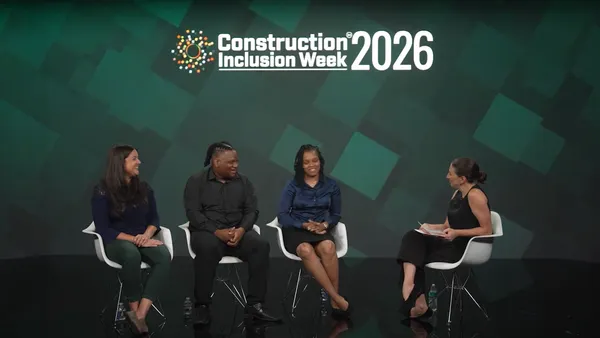
“I totally empathize with older generations that it can be so hard to stay up to date,” Cure said, also during Construction Dive’s virtual event. “I think the biggest missed opportunity is genuinely in a lot of businesses that we work with, is they don't utilize the strengths of zoomers in their organization as much as they should.”
Still, some construction leaders have made those changes. For example, Nicole Hajjar, assistant project manager at Suffolk who graduated college in 2023, says she’s often assigned tasks precisely for the skillset afforded by her age.
“There might be some new app or website that's being promoted and it's like, ‘Oh, give it to Gen Z, let Gen Z handle it and then show us. Once they get it down, let them show us how to do it,’” Hajjar said.
Perhaps most importantly, Hajjar says the organization appreciates her role as the tech unscrambler.
“I feel like I get a lot of kudos for it,” Hajjar said.
Bridging the tech gap
They can name their browser, but the Gen Z construction professionals I spoke to for this column also recognize what they can’t do. Even if it was a rude awakening.
“After graduating, I felt like, oh, I have all this knowledge. I am just going to go right into my job and like, do it 100% with what I know. And I got it. It's easy peasy,” said Jacquelyn Lomano, project engineer at Milpitas, California-based XL Construction. “I get here and I sit in on an OAC meeting and I'm like, ‘What are you guys even talking about?’ Like, I have no idea what's going on.”
Lomano was also a panelist at the virtual event, and, at the time, was just on her second week of work at XL after graduating from Cal Poly San Luis Obispo in June. After that meeting, her mentor helped her realize that it may take her a year or so to get into the swing of things, and that that was okay.
Of course, it’s only logical that while zoomers grew up with tech, those senior colleagues were gaining a wealth of other experience. Though the industry shoulders a luddite reputation, or carries the albatross of the expression “we’ve always done it this way,” Mendoza said it makes sense that these seasoned professionals haven’t made time for every new shiny tool.
“There’s so much going on and he didn't have the time to just sit down and learn it, right?” Mendoza said of the superintendent to whom she taught common apps. “It was reverse mentoring. And I like that word to describe what it was because I was learning his entire career knowledge, but I was also teaching him how to document everything and just streamline it.”