

Building a training facility for a professional sports team already comes with extra considerations, particularly around utilities to support health, wellness and tech.
To construct a temporary training facility in less than three months using modular units assembled by offsite construction firm WillScot required a detailed playbook and coordination a Super Bowl-winning team would envy.
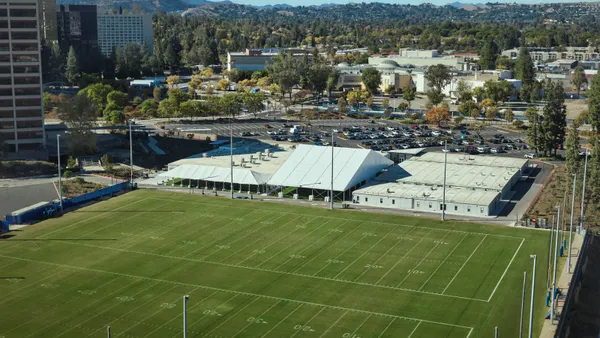
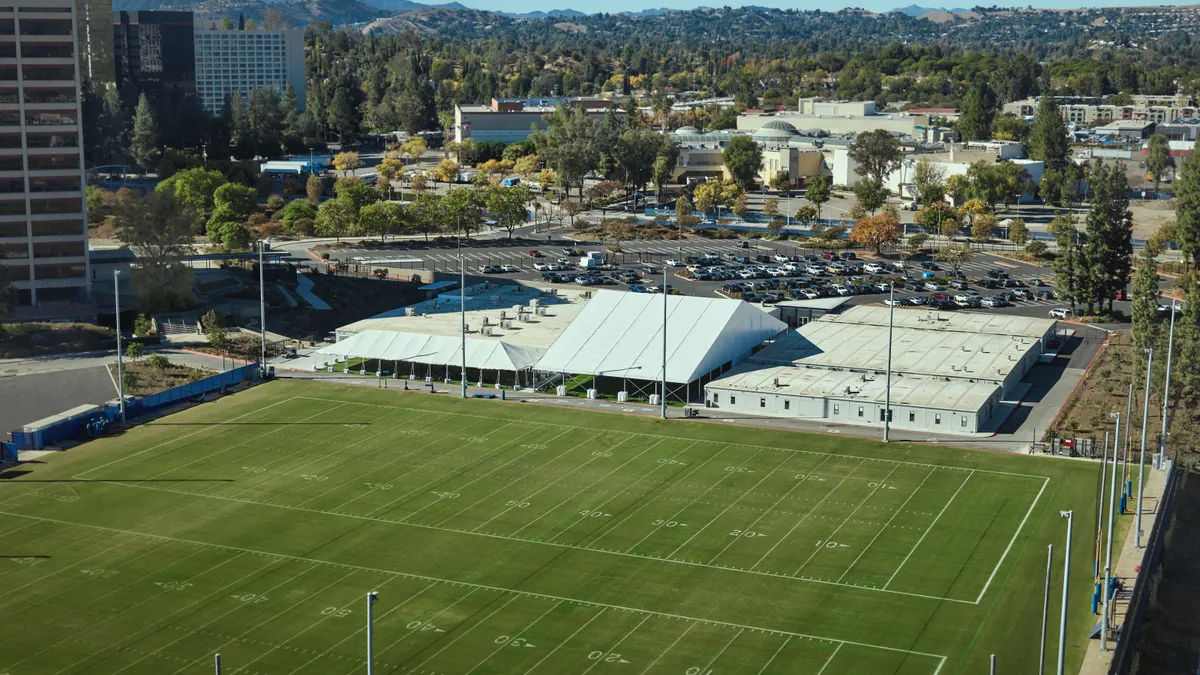
The Los Angeles Rams’ current training facility, built in 2024 and still in use, is a 64,670-square-foot complex with locker rooms, team offices and media spaces. Designed by Gensler, the structure is made up of 88 modular units made by WillScot.
Here, Construction Dive talks with Sven Louis, WillScot’s senior director of fleet operations, to learn more about the build, the true timeline behind the 2 1/2-month jobsite sprint and the challenges unique to an NFL modular facility.
Editor’s note: The following has been edited for brevity and clarity.
CONSTRUCTION DIVE: How did this project come together in 2 1/2 months?
SVEN LOUIS: The 2 1/2 months was really the delivery and installation phase. There was a lot of pre-work to that. Then there was almost a year worth of planning to ensure that we could execute it in those 2 1/2 months, which started around February 2023.
One of the reasons that we were engaged early was so that we could collaborate with the design and planning team from the start. We were slowly building the team to detail out all the designs and plans that were needed. As you're doing that, you're creating your budgets. The team slowly built from all the specific construction trade groups. We were updating plans, distributing them to all parties so they could provide their feedback.

And then there was a bit of a pause in December 2023. Because once you have those final plans, that's when you have to determine the costs, schedules and availability. We started swinging hammers off site around February 2024. We got probably 75% of the work done off site.
Once the foundation was ready, then we came in, crane-lifted the units onto the foundation. Then it became a mad dash for all of the trades to get inside the building and complete their work. And there were a lot of trades. There were hundreds of people on that site at that given point in time, each hyper-focused on coordination. Everybody’s overlapping each other, so they had to be hyper-focused to make sure they met those milestones.
Why was modular and offsite work the right choice for this build?
The reason why the modular industry is so successful is really because of speed.
As we were repurposing these buildings off site, they were doing all the civil work off site at the same time. In traditional construction, you don't really have the ability to do that. You wait for all the civil work to be done, and then you start your vertical construction.
This was the only solution that could work in the timeframe in which the Los Angeles Rams had provided to us.
What posed the biggest challenge on the project?
There's probably two things. The construction aspect, think about all the specific trades. You got the electricians, plumbers, etc. One of the most difficult things was getting all those people on the same page. Going back to what I said earlier: The team was stellar, but that didn’t happen overnight.
Because of the time commitments and expectations, we really had to dial in to understand the capabilities of trades that were there. We had to really get to know these people, their foremen and their crews. Are they working safely? Are they showing up on time? Are they working late? When they say they're going to do XYZ at a certain time, are they actually doing that? Is everybody working behind each other? Are they communicating their problems?
That team development was one of the hardest things. Once everybody got on the same page, it was a pretty cool thing to do for this project.
The other thing was the space. You're working in such tight boundaries, you have 88, 12-foot by 60-foot units coming into play, where do you put them? How do you maneuver things? The coordination around that was a lot. For example, somebody has material that's in your way, somebody's digging a ditch, and you need to drive over that ditch to get to another spot. The crane's coming. All of those pieces and coordination around space is probably the most typical thing.
How did this differ from other, temporary modular structures?
The difference here is the specialty items that go around providing a state-of-the-art facility to the Rams. A lot of the pre-work and planning that was done required looking at some of the space solutions that we had to provide.
It’s four buildings that hold the 88 units, and it has a locker room. But that's just not any standard locker room. They had specific Los Angeles Rams lockers that needed to be brought in. They had a dining hall, prep kitchen, which was interesting because that was a health department application.
Then there was the weight room. Not only is the equipment heavy and the weights heavy, but you've got some pretty big NFL players coming in there and using this equipment. And when they start using the weights, what usually happens when the weight lifter is done? They drop them. So we had to put steel sheets across the entire floor to ensure that those particular weights wouldn't go crashing through.
There are industrial laundry washing machines and dryers. Not like the residential stuff, bringing some big machines that tend to vibrate a lot. So there was special structure consideration for that. A hydrotherapy room meant we had to bring jacuzzis in.
What should owners, architects and contractors know about considering the offsite method for a future project?
The LA Rams, Gensler and Legends team were adamant about including us in those initial conversations to make sure they were steering into our types of products as a solution because we can really speak to what our capabilities are.
Otherwise, if they didn’t, they could have gotten something completely different stuck in their head. At the 11th hour, to come to the table and say, "This is what we want,” that becomes very difficult to provide a solution for.