
Despite the economic headwinds, Southern Land Co. has continued to build.
The Nashville, Tennessee-based full-service developer has started projects in its established markets, including apartments in Las Vegas and White Plains, New York, Matt Ritsko, president of construction at Southern Land Co., told Multifamily Dive.
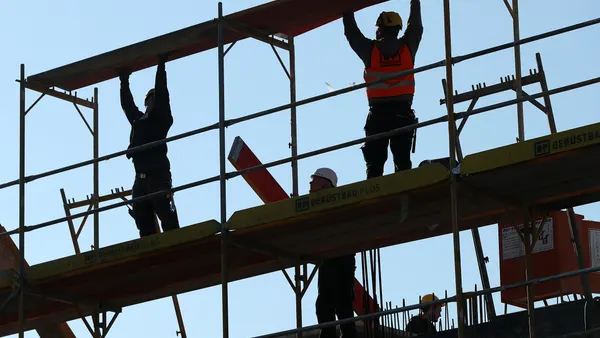
But it hasn’t been easy. Fluctuating project timelines, demand and prices for labor and key materials like rebar and drywall have caused confusion within the construction real estate industry, Ritsko said.
In that “ever-changing environment,” contractors have been reluctant to take risks when setting labor rates, providing efficiencies, reducing margins or pricing materials, Ritsko said. Rather, contractors “are building more contingency into their pricing to account for them.”
As Ritsko’s story shows, multifamily is still in the nascent stages of its construction recovery almost a half-decade after building started slowing.
Multifamily and single-family housing production has been down since 2022, when interest rates surged — driving up the cost of capital and limiting investor demand, said Jay Hiemenz, chairman and CEO of Alliance Residential Co.
With the slowdown, contractors are vying for a limited number of apartment projects and materials prices have moderated. But those trends haven’t necessarily translated into significantly lower construction costs and more opportunities to build.
Challenging economics persist
Although increased contractor competition is encouraging, labor costs haven’t fallen enough to make development pencil out in more metro areas, said Patrick Kassin, senior vice president and regional development partner at Woodfield Development.
“We haven’t seen costs come down enough to suddenly make a lot of markets work that didn’t work six or 12 months ago,” Kassin said.
Tommy Gallagher, Middleburg Communities’ head of construction, has seen construction costs stay relatively flat this year, with modest declines in specific markets. However, more competitive pricing due to higher bid participation is being offset by some higher materials and commodities costs.
Materials pricing has become more predictable than it was a few years ago, but a lot of those costs stabilized at a much higher level after the run-up in costs in the early 2020s, according to Kassin.
“We’re hopeful we’ll continue to see material costs normalize,” said Kassin. “Stabilization is good, but we really need costs to continue working their way down.”
However, tariffs and uncertainty around the Trump administration’s trade policies have added to Woodfield’s concerns around pricing, Kassin said. That’s particularly true when the company tries to underwrite a development project that may not actually break ground for 12 to 18 months.
Beyond labor and materials costs, permitting timelines and utility coordination have also slowed projects down in some jurisdictions, said Gallagher. Those delays have affected project schedules and profitability.
But those aren’t the most important inputs when determining the feasibility of building a new apartment community. “Interest rates, capital markets, land basis and achievable rents still determine whether most projects move forward,” Gallagher said.
Similar volume to 2025
Even though underwriting remains a moving target, experienced, well-capitalized developers are still moving forward on projects as they see an opportunity to be first to market.
With costs stable or declining in some areas and the heightened contractor competition, Gallagher said he believes the current construction market presents an opportunity. Middleburg is expecting to break ground on more projects in 2026 than it did in 2025, he said.
“Development cycles are long, and waiting for every variable to align can mean missing the window when construction pricing is most favorable,” said Gallagher. “For projects with strong fundamentals, we see real value in moving now, ahead of a supply pipeline that's expected to stay constrained.”
Alliance has seen costs fall enough to make development worthwhile in some additional metros, where the market’s demand and absorption are also right, said Hiemenz. The developer projects it will ultimately break ground on about the same number of multifamily projects by the end of 2026 as it did in 2025, he said.
Meanwhile, Woodfield is working toward several potential project starts this year, but is being disciplined about the ones that are moving forward, said Kassin.
“We’re not going to start a project just to maintain a certain level of volume,” said Kassin. “If we continue to see improvement in both the capital markets and construction pricing, I think you’ll see more projects move forward.”
Click here to sign up to receive multifamily and apartment news like this article in your inbox every weekday.