On a number of construction sites, the excavator cab is now empty.
Bedrock Robotics, a construction technology firm, has launched fully autonomous excavators on a number of active U.S. construction sites, the San Francisco-based company announced Monday.
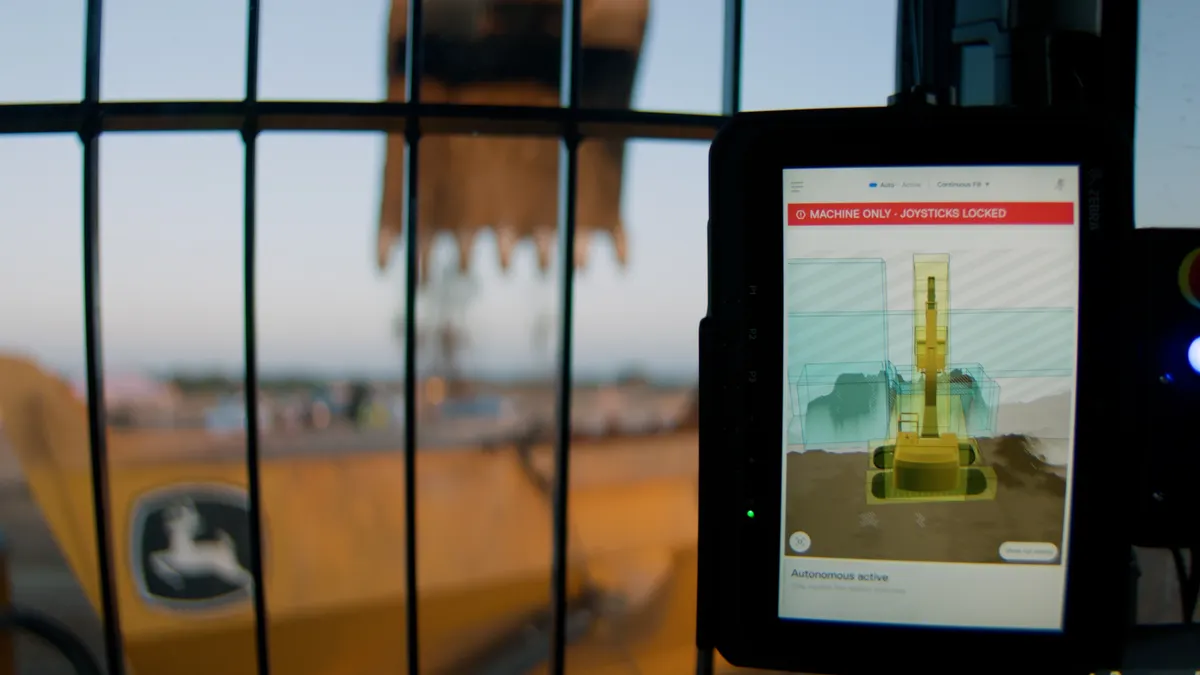
The excavators use Bedrock’s Operator system, which retrofits existing fleets with a sophisticated sensor and compute suite to perform excavation without onboard operators, according to the company. The tool is now active on critical infrastructure sites, including a Nevada-based water treatment facility in partnership with Sundt Construction and a 1.2 million cubic yard civil sitework project with Zachry Construction.
The announcement marks the technology’s readiness for fully autonomous activity after a year of testing under human supervision, according to the release. It also comes as robotics gains momentum in the building sector.
For example, the same day Bedrock released its update, Switzerland-based Gravis Robotics announced it had snared $200 million in Series A funding from global tech investment giant SoftBank.
Bedrock’s system, once equipped on excavators in a same-day installation, can perceive its environment and ultimately execute complex tasks autonomously after a site manager sets the initial plan. The upfitted excavators can operate in normal site conditions alongside other equipment, and will stop automatically if they sense a person or another object gets too close.
“Our sensor suite and machine learning models are designed with safety in mind, and have been rigorously tested in real world environments and in simulation,” Boris Sofman, CEO of Bedrock Robotics, told Construction Dive. “Our sensor layout gives the machines a 360 degree field of view, eliminating the dangerous blind spots for human operators. These machines will only operate autonomously in conditions that have been approved, and if the system detects any faults, it pauses work and comes to a stop.”
Bedrock says excavators typically take about five years to master, which ranks them among the hardest machines to predictably staff with skilled operators. For that reason, Bedrock prioritized its automation tech on excavators, which often make up 25% of a contractor’s fleet, according to the release.
“We are seeing increasing projects with millions of cubic yards of earth to be moved,” Sofman told Construction Dive. “As we expand to broader operational hours, such as night-time, and automate more machines that work together with excavators, we can directly compress the schedules of these projects and provide huge value to both the contracts and their end-customers.”
From robotaxis to jobsites
Bedrock’s co-founders and much of the early team came from Waymo, the robotaxi company that now offers autonomous rides in 11 cities nationally, including San Francisco.
Although Waymo’s tech has earned initial laurels, with the Insurance Institute for Highway Safety finding Waymo’s cars were in fewer crashes than those driven by humans, it has also had its hiccups. During San Francisco’s America 250 celebration July 4, dozens of Waymo vehicles contributed to a massive traffic jam when they were unable to navigate during the gridlock.
Those types of issues should be less prevalent on jobsites, Sofman told Construction Dive.
“Bedrock’s machines, by nature of how they’re used by our customers, will be distributed across sites all over the country,” Sofman said. “This minimizes our risk exposure to these types of surges.”
Sofman expressed goals to extend Bedrock’s autonomous tech to other heavy equipment on jobsites, including dump trucks, dozers and loaders, according to the release.
“Excavators are only the starting point for Bedrock, and we specifically built our technology and infrastructure to extend far beyond a single machine type,” Sofman told Construction Dive. “Eventually, we’ll expand to other highly used and in-demand machines.”
In February, Bedrock Robotics announced it raised $270 million to scale its autonomous construction technology. The firm launched out of stealth in July 2025 with $80 million in Seed and Series A funding.