Dive Brief:
- Gravis Robotics, a robotics-focused construction tech firm, has raised $200 million in a Series A funding round from global investment firm SoftBank, according to a Monday announcement.
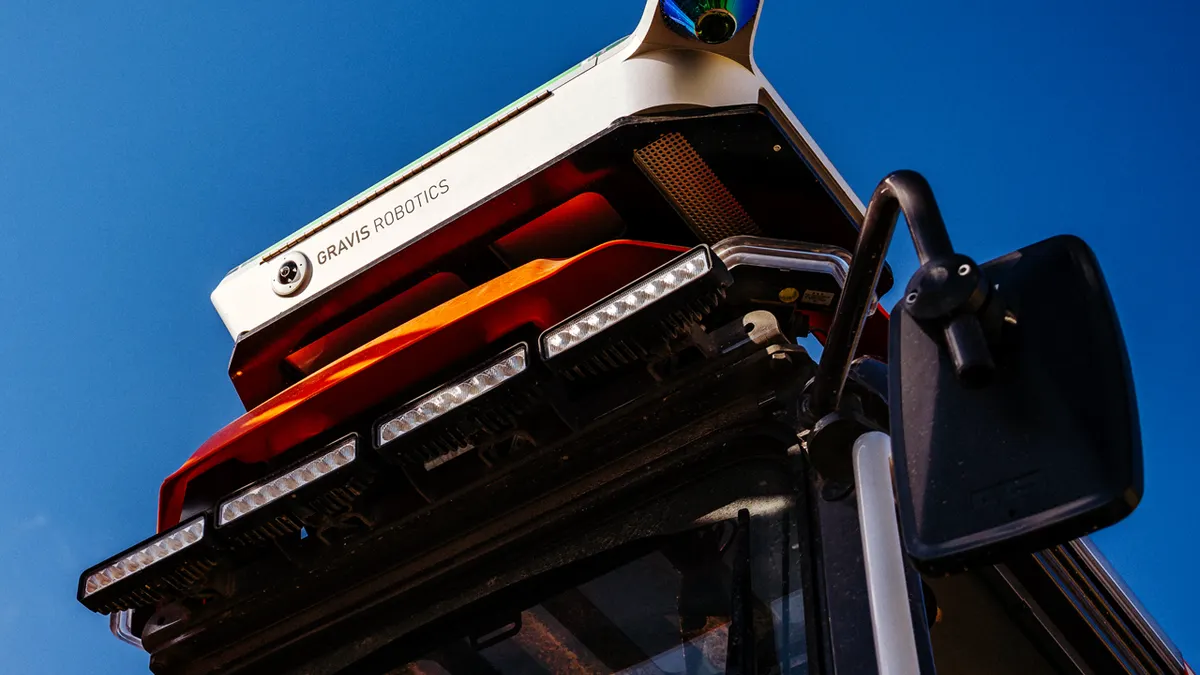
- Gravis, founded in 2022 as a spin-out of ETH Zurich, a Swiss public university, uses its proprietary retrofit technology to turn heavy machinery on construction sites into autonomous robots, according to the firm. Gravis uses artificial intelligence to train its tech as an operating system for fleets, while its Gravis Rack, a physical bolt-on, sits atop a machine to control it.
- The $200 million in cash is a large sum in the construction technology space, and represents a bet by a large institutional investor that physical AI is on investors’ radars.
Dive Insight:
Alongside fully autonomous control, Gravis offers Gravis Copilot, a tool that gives users AI-augmented manual control, per the firm. With the copilot, operators can remain in the cabs while Gravis’ AI offers real-time 3D guidance and hazard detection. When the machine is fully autonomous, operators can leave the cab to monitor fleets from a separate location.
The tech can be used across common brands of heavy machinery, per the firm. Examples include Caterpillar, Hitachi, Volvo and John Deere machines.
“Physical AI is central to SoftBank’s vision for the next phase of AI,” said Dai Sakata, managing director of SoftBank Group, in the announcement. “Gravis is bringing AI-powered autonomy to construction, helping build smarter, more efficient infrastructure, and we look forward to supporting its mission.”
Indeed, other large investment rounds have also followed robotics firms. Last year, Irvine, California-based FieldAI, which focuses on physical AI for robotics, raised $405 million across two consecutive funding rounds. FieldAI received legacy support from tech giant Nvidia and Microsoft founder Bill Gates.
However, robotics still face hurdles to take off in construction. Robots struggle to operate in unstructured environments including jobsites, where plans, materials and the physical layout can change daily, if not more frequently. Gravis contends its technology is built to withstand those dynamic conditions.
“Our machines are built for the messy, unscripted reality of live jobsites that breaks traditional automation,” said Ryan Luke Johns, the firm’s CEO and co-founder, in the news release.
Johns told Construction Dive via email that the firm’s offerings are built with small and mid-sized contractors in mind.
“Our cost is competitive with premium machine control systems, while offering features that further improve productivity and safety: augmented grade visualization, live as-built 3d scans, human form recognition, and autonomous excavation,” Johns said.
With the funding, Gravis will continue to deploy its solutions at scale and continue to expand, per the announcement.