Water is life. Just ask Jaren Murphy.
Murphy, the president of water for McCarthy Building Cos., is based in Phoenix, where the impacts of low water levels in the Colorado River are front page news.
He took over the helm of the water sector for the builder this month after serving as the water business unit leader and senior vice president since September 2024, according to his LinkedIn. Murphy is bullish on the future of water projects, a view that could be bolstered by a $30.5 billion federal investment in the space.
Here, Murphy talks with Construction Dive about how he’s seen the water market change, what McCarthy looks for in selecting water projects and how projects can differ based on geography.
Editor’s note: This interview has been edited for brevity and clarity.
CONSTRUCTION DIVE: How has the water project market changed over the last five years?
JAREN MURPHY: It's been an incredible ride over the last five years.
We'll go back to 2021, when a $200 million to $250 million project across the U.S. was a really big project. And at that time there was really only one $1 billion project, which was the Northeast Water Purification Plan for the city of Houston.
Today, almost every large municipality, water resource district, whatever it may be, has a billion-dollar-plus capital improvement plan and is trying to improve infrastructure, building new plants. The overall growth of this market has really been incredible the last five years.
There’s many different growth drivers. A lot of it is geographical.
In the West, much of it's driven by the Colorado River, the drought we've been experiencing. There’s a lot happening around advanced water and water reuse, to be able to recycle water after it's used by cities and by industries, making sure we're getting every last drop in the Southwest.
In the East and Midwest, it’s driven by older infrastructure, hurricanes and being able to handle large volumes of water during storms.
How has McCarthy’s water business specifically changed over the past five years?

Right now, overall, it's about 5% of the overall construction that McCarthy does. That's been fairly consistent. As McCarthy has grown, the water business has grown.
That's driven by larger and larger projects across the U.S. in different sectors: healthcare, mission critical and data centers, solar, renewable energy. There are many things that are growing in size and growing in dollar value. So that percentage for water has stayed the same, even though it represents a bigger dollar value.
What does McCarthy prioritize when seeking out water projects?
We're looking for 100% collaborative delivery in our water projects.
We're looking for a construction manager at-risk or design-build, progressive design-build primarily, where we can get involved very early on in a project. That helps us understand the trajectory of the project, the technologies used, obviously the budget and how we're going to find the craft labor to build the project. We like to get involved from a very early stage in those projects and partner with our owners and our engineers.
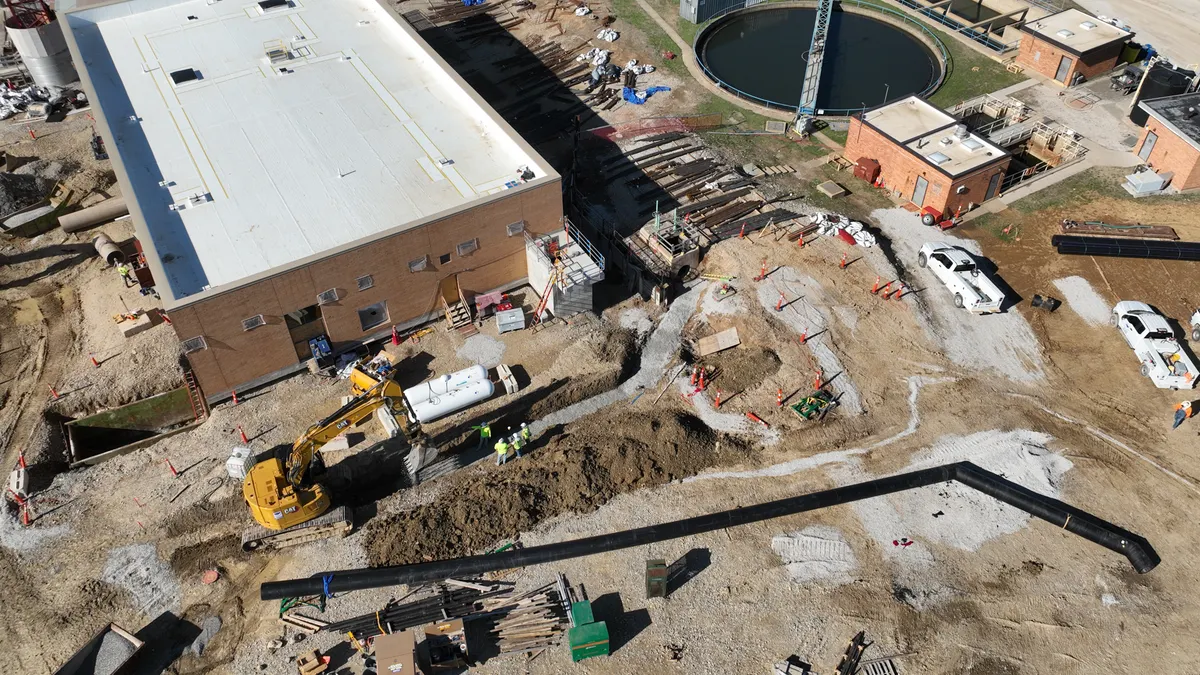
Many of our projects are, basically, where we're changing out the drain on a kitchen sink while the sink is running.
You can't shut down a plant. It has to keep creating water and has to keep treating water. And there's a lot of things that are very complex on how you're going to build it, or how it's all going to come together.
It may look like it's going to work in a two-dimensional format on a plan or a spec, but how you go do it in real life with the people, the machinery and the equipment, may be very different.
In a traditional hard-bid environment, it's very hard to come together to figure out some of those solutions because they're kind of figured out without the people that are going to go build it. So, if we can get involved early on in that, then we can drive more of that collaborative approach towards success.
What are your predictions for the next decade?
I think that the Colorado River’s impact on the Southwest is not going away. We're going to feel the impact of that for a long time.
In the Southwest, the demand to build advanced water plants and bigger solutions is going to continue to drive the market for the next 10 to 15, even 20 years.
I think that aging infrastructure in the Midwest is only just beginning. The majority of the plants were built in the '60s and the '70s, and they're built for 50 years. So now, we're right in the spot where we need to upgrade our plants, our technology, things need to be changed when it comes to that aging infrastructure.
And then places like Texas, they're continuing to need different water resources and ways to treat water. And because of all the money coming in from those industries, I think we'll continue to see big tailwinds there.
I think that this market is going to continue to break records with the number of dollars that are going to be put into water, because nothing grows without water. You can't grow a community, you can't grow a city, you can't grow an industry without water. So it's going to be at the front end of all this growth.