

Dive Brief:
- A Maryland contractor is partnering with a nonprofit and North Carolina State University to better understand upgraded protection for construction workers’ heads, per a release shared with Construction Dive.
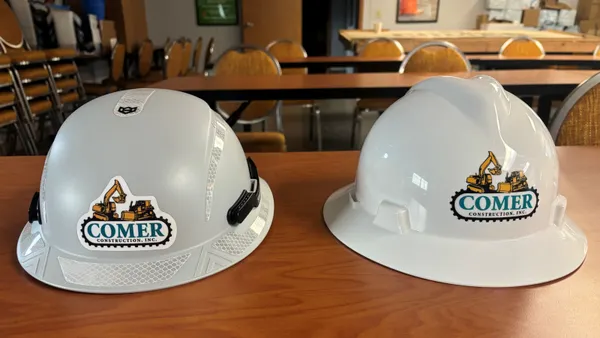
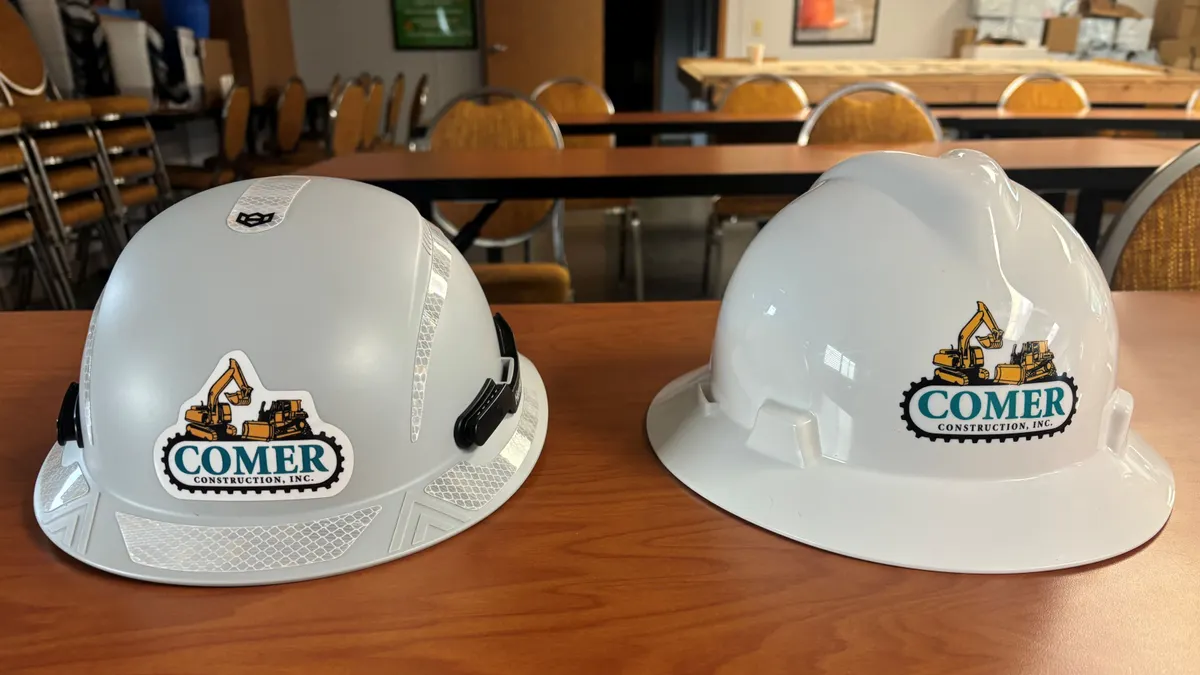
- Forest Hill-based Comer Construction, which performs subdivision work for commercial and residential builds, will participate in a pilot program to evaluate the practical considerations, effectiveness and feasibility of implementing Type II helmets on active jobsites. The selection stems from a grant to N.C. State from the Job-Site Safety Institute, a nonprofit.
- The program’s goal is to better understand how to pivot from traditional hard hats to Type II safety helmets, which stakeholders say more effectively protect workers’ heads.
Dive Insight:
JSI was founded in 2014 by leadership from Raleigh, North Carolina-based Builders Mutual Insurance. The initiative stemmed from wanting to ensure companies had all the tools necessary to keep workers safe, said Jodi Vedelli, chief strategy officer at Builders Mutual.
“People are still getting injured on jobsites,” Vedelli told Construction Dive. “There was this feeling of, ‘What more can we do?’”
Since its founding, JSI has awarded $1.13 million in research and education grants to partners addressing safety challenges across the construction industry.
Indeed, the grant to N.C. State is an extension of a previous funding for research on construction personal protective equipment, said Alex Albert, associate professor in the department of civil, construction and environmental engineering at the university. That study looked into construction workers’ general awareness of the differences between various PPE headwear.
“The finding was that workers were largely not aware of the distinction between Type I and Type II safety helmets,” Albert said.
Type II helmets come with a chin strap and are designed to protect a worker from falls or struck-bys contacting the top or sides of their heads. Type I helmets, on the other hand, come with no strap and protect just the top of the head. Research from Virginia Tech has indicated Type II helmets can better protect workers from severe injury.
Approximately 200 construction workers die from traumatic brain injuries in the U.S. each year, according to the release.
In the N.C. State study, workers were on board with making the switch to Type II, once they understood how it could keep more parts of their brain safe, Albert found.
Still, they had concerns, namely the cost. Companies and workers can usually buy traditional hard hats from their local hardware store for about $15, said Erik Anderson, vice president of Winston-Salem, North Carolina-based residential renovation company Anderson Moore Kitchen & Bath. Type II helmets often cost over $100, he said.
Susie Comer, president of Comer Construction, acknowledged that the adoption of Type II helmets did pose a higher cost than the use of traditional hard hats, but she thought it was worth it.
“That was a hit,” Comer said, but after considering the increased safety benefits, it was “almost a no-brainer.”
Vedelli said the nonprofit’s goal is to reach smaller firms with fewer resources for safety practices.
The use of safety equipment has varied between industry sectors over time, Anderson said. But that’s starting to change.
“In the commercial world, the hard hats have been accepted,” said Anderson, also the board chair of JSI. “I wish it were that way in residential.”
Ideally, this partnership will bridge the gap, Albert said.
“We hope to create an authentic industry example of what it takes to move from hard hats to Type II safety helmets,” he said.