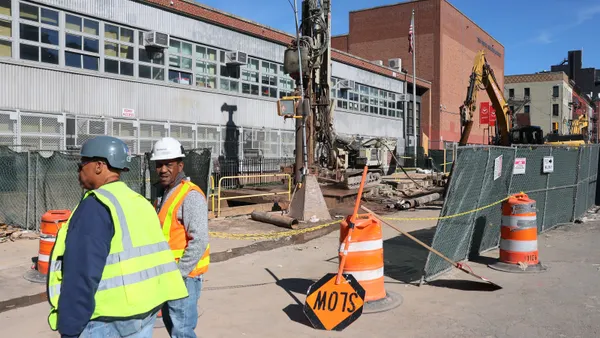


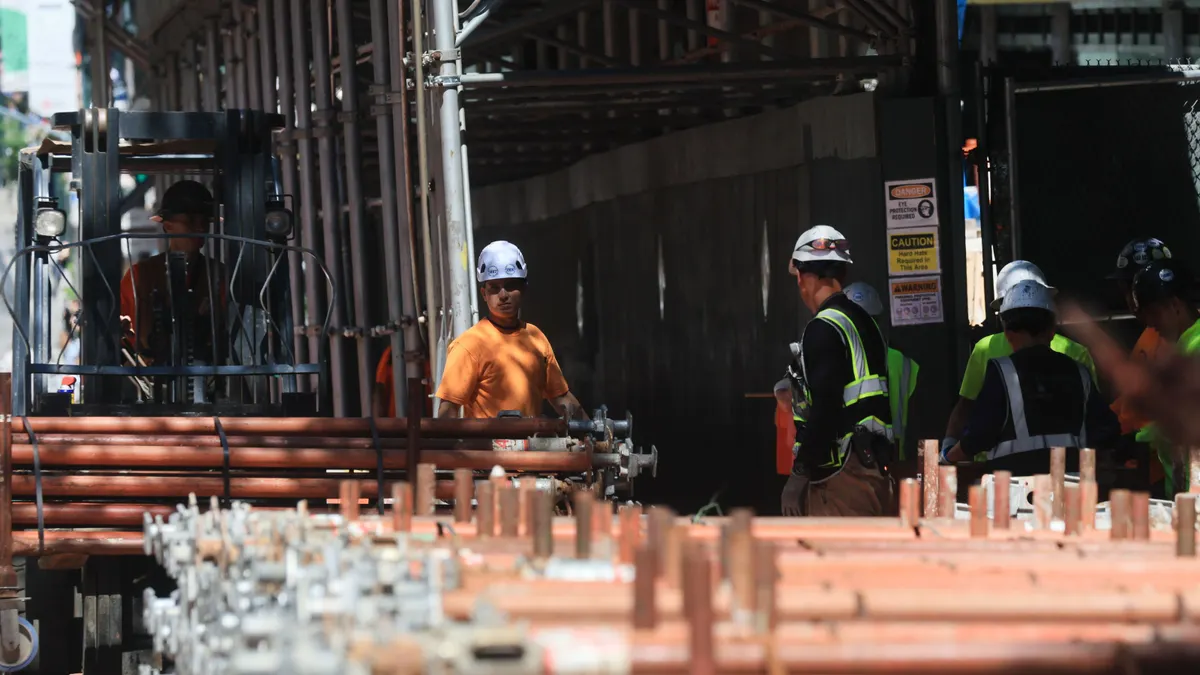
City officials ordered the partial construction stoppage of a third office-to-residential conversion project in Manhattan on July 28, The Wall Street Journal reported.
The pause on work at 750 Third Avenue followed the halt to work at 222 Broadway on July 30, according to The Wall Street Journal. Both of the orders resulted from enhanced Department of Buildings outreach and inspection following a structural failure on the former Pfizer building office conversion job on July 7.
Experts told Construction Dive the enhanced scrutiny and number of work stoppages are both predictable and unprecedented. Though it’s ordinary for an agency such as the DOB to ramp up enforcement and outreach following a headline-grabbing occurrence, the size and scope of the response is unique.
“Whenever a major incident occurs, the government often responds with more scrutiny. That is normal,” said Dan Rosenberg, principal at Much Shelist in Chicago. “The pure scale and scope of this incident is staggering, however.”
Sources, in part, attributed the heightened response to New York City being the largest and most densely populated city in the country and the high value of its real estate, much of which is currently being converted.
“When DOB sees [a structural issue], they will look at similarly situated projects to ensure those are proceeding safely. In that type of situation, the inspectors err on the side of safety, stopping any work that deviates from the code or approved plans,” said Carol Sigmond, New York City-based partner at law firm Nossaman. “That is what is happening now.”
Violations on every building
Then again, the rules and regulations around construction, especially in the Big Apple, are so numerous that it’s hardly surprising structures weren’t in perfect compliance to begin with, experts said.
“It’s impossible to find a building in New York City that doesn’t have a violation on it,” Joe DiPompeo, president of New Jersey-based civil engineering firm Structural Workshop, told Construction Dive. “If you go out and scrutinize every major construction project in Manhattan, I expect you’ll find a violation on most or all of them.”
Many of the violations across Manhattan are small, often related to compliance. Existing buildings converted to new structures often run into unexpected field conditions that require design changes, said Trent Cotney, Tampa, Florida-based partner at law firm Adams & Reese.
“The key question is whether those changes were properly documented, inspected and approved. A sound field modification can still create a compliance issue if the required process was not followed,” Cotney said.
Indeed, in the case of 222 Broadway, the second halted office-to-residential conversion job, beams that cracked in March were repaired quickly, the Wall Street Journal reported, but they weren’t reported to the city. That stop-work order resulted from a timeline discrepancy rather than severe safety issues, per the Journal.
Construction codes evolving
The DOB is required to continuously identify safety issues for the purposes of updating codes, Sigmond said.
“If they are seeing issues in conversions, they may consider making code changes in the interests of public safety,” Sigmond told Construction Dive. Ensuring structural steel in conversion projects is strong enough to support the building is an example of something the DOB could consider, she said.
At the same time, DiPompeo said he thinks the inspections and work stoppages are an outreach effort, in a sense, to let the public, builders and owners know that the DOB is paying closer attention. He pointed to the fatal, 2023 collapse of a parking garage on Ann Street in New York, as an example of that campaign to “get the story out.”
In response to the parking garage’s collapse, “DOB sent a wave of inspectors, writing violations left and right for anything and everything,” DiPompeo said.
With that in mind, DiPompeo doesn’t believe a lack of regulation led to the structural beam failure on the former Pfizer headquarters. Instead, crews or inspectors likely didn’t follow existing protocol in some step of the process.
“I don’t think the wheel has to be reinvented here,” he said.
Long-term impact on similar projects
If code changes don’t follow, other impacts are still likely to strike the office-to-residential market, as well as the greater New York City construction sphere.
“I think everyone in NYC needs to be braced for more inspections and tighter inspections,” Rosenberg said. “For projects underway, that likely means slower progress. And as we all know in construction, time is money. I don’t think this stops most projects underway, it slows them down.”
Though the halted projects may proceed after additional engineering review, those delays can increase costs and create disputes with owners, Cotney said. That impact on the individual projects could ripple out to other builds. And changes to inspection standards may not be limited to those followed by the DOB.
“Developers, lenders and insurers may also become more cautious, with greater emphasis on independent structural reviews, stronger inspection controls and larger contingencies,” Cotney said.