An expensive materials market is making one of construction’s less conventional alternatives worth another look.
Prices for steel have climbed 25% over the past year, said Tom Park, vice president of the strategic supply chain at Skanska, during a Sept. 10 webinar on materials costs. Lead times, on the other hand, have more than doubled to 55 weeks.
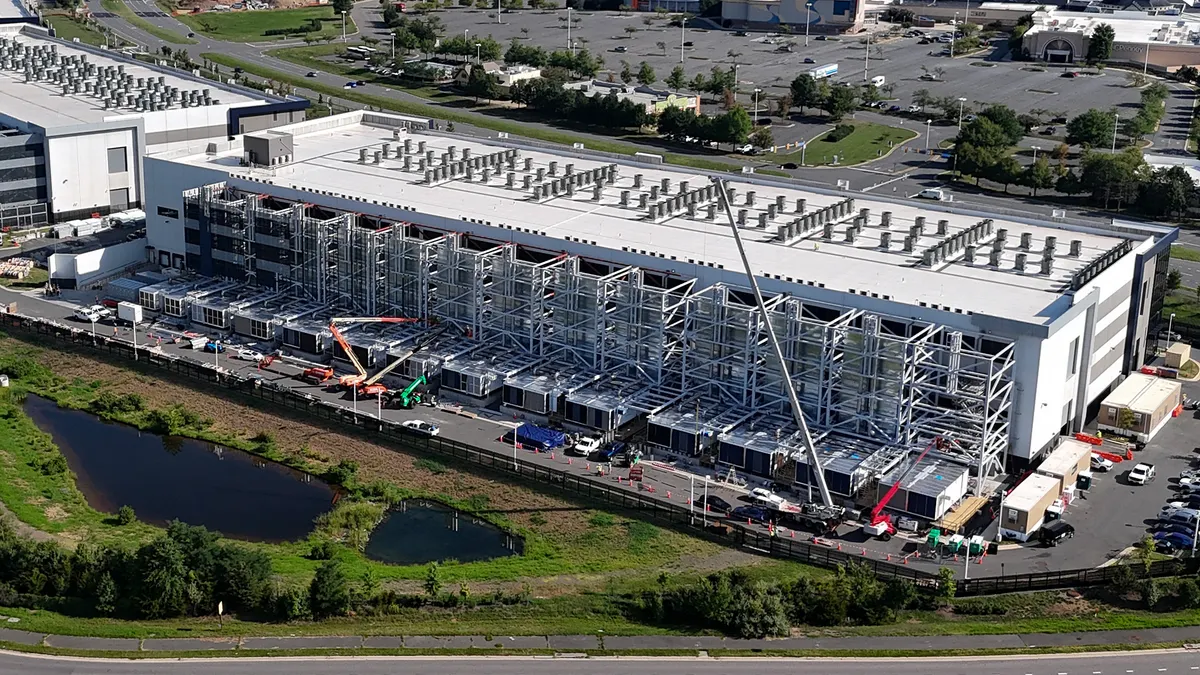
Blame the price jump on the rush to build data centers and semiconductor plants, Park said.
“Very strong demand for steel and other metals because of the AI rollout,” he said. “Currently, both steel mills and steel fabricators are running at full capacity.”
The demand, coupled with tariffs, mean contractors are now looking at mass timber as a way around those logistical bottlenecks, said Dean Lewis, director of mass timber and prefabrication for Skanska.
“We’ve seen a lot of interest,” said Lewis when asked about demand from data center customers during the webinar. “Clients are interested in alternative materials given the supply chain strain in general across all materials.”
Mass timber, however, is pricier than steel upfront. The timber frame itself generally costs more, Lewis said, but savings could start to appear over the course of a project.
For example, Skanska studied a three-story office project where the timber gravity frame cost more than its steel counterpart. Savings on the foundation, lateral system, finishes, facade and construction schedule eventually brought the two options close to cost neutral.
“[Mass timber] has a lighter structure, so you can have reductions in the foundation, reductions in the lateral and then the MEP, if it’s integrated efficiently, should really have no cost impacts,” said Lewis. “There should be savings on the interiors. Obviously, because of its prefabricated nature, mass timber lends itself to an enhanced schedule, so there’s potential savings there.”
Lumber costs show stability
Despite tariff pressure on Canadian softwood lumber, lumber price escalation sits in the range of 0% to 3%, said Park.
“The big story in the news has been the trade war with Canada, which is significant because roughly 25% of softwood lumber consumed in the U.S. does originate in Canada,” said Park. “Even though softwood lumber is under tariff pressure, the low demand from the residential housing market has kept lead times low.”
Lumber accounts for about 65% to 70% of mass timber input costs, said François Robichaud, partner for market intelligence on wood products and construction at Forest Economic Advisors.
“While we have seen on the steel side of the equation sharp increases in prices, mass timber has proven to be much more stable as of late,” said Robichaud during the webinar. “Should be remaining so for the foreseeable future.”
In addition, manufacturing capacity for cross-laminated timber and glued-laminated timber has expanded significantly over the past decade, but actual production still sits below total capacity, he added. That means North American producers should have no problem with accommodating future demand, according to Robichaud.
The constraints on mass timber adoption
Headwinds still exist for the expansion of mass timber, in addition to higher upfront costs.
Builders’ risk insurance is higher for the mass timber option when compared to steel. Skanska is working with the Department of Agriculture on a study of strategies to help lower those insurance premiums, but Lewis expects the research to take between one and a half to two years.
A bigger constraint occurs before manufacturing begins, Lewis said, because design and coordination often determine how quickly contractors get material to the jobsite.
For example, on one recent project, Skanska went quickly, in about three weeks, from contract execution to timber onsite. However, other projects that required teams to coordinate penetrations through cross-laminated timber and glulam took four to five months, said Lewis.
“The design and coordination of time is really the lead time,” said Lewis. “The lead time is not really reliant upon the actual manufacturing timeline.”
The workaround is for contractors and owners to agree on structural decisions as early as possible.
Timber upfront versus pivoting later
Though projects initially geared around steel or concrete can be converted to mass timber, they risk losing some of the cost efficiencies, said Lewis.
“We see some teams sometimes where they come and they want to take a design that is steel or concrete and convert it to timber, which can be done, and we can help with that, but definitely need the design with timber in mind. It’s going to take its own grid layout again,” said Lewis. “So, if you’re not designing like that, early up front and having timber in mind, that can be difficult.”
Along with the structural decisions, contractors also need to coordinate with mechanical, electrical, plumbing and fire protection trades because timber components arrive on the jobsite prefabricated.
“There’s going to be a more upfront, conservative effort in planning when it comes to mass timber,” said Lewis. “There’s also going to be deposits that are going to be required earlier on.”