
Most conversations about field technology start from the wrong premise. They assume the goal is to generate more documentation, like more check-ins or more photos, as if there's not enough of that being collected already. But there is – more than enough. The issue is that the record of the work being done scatters right after it's created, disappearing into a text thread, a paper binder, a phone call or it's lost in a memory that fades by Friday.
This means that a lot of major jobs effectively run blind for hours at a time most days, in that workers see what's happening, but everyone is watching separately. The electrician has a photo, the concrete crew made a call and so on, but all these pieces of proof haven't been connected to give everyone the full picture. Because proof alone is not the same as operational information, which is data that arrives in context and that can be acted on. And it's only when you have truly operational information that you can transform how a project is orchestrated, not just run.
The fragmentation gap
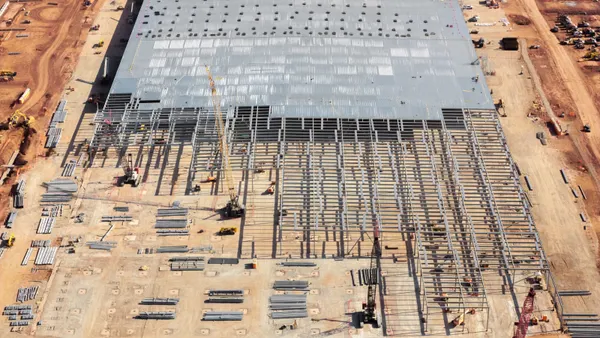
Consider a multi-million-dollar vertical build with six subcontractors on site: electrical rough-in in one wing, MEP coordination in another, a concrete crew pouring a slab on grade out back. Every one of those teams produces its own version of proof, in its own format, on its own schedule. None of that information is missing, but it's likely moving through five disconnected channels, each with a different delay and a different chance of getting lost before it lands on anyone's desk.
Nobody's second-guessing their crews, but managers and owners are left trying to pull one clear, consolidated picture out of five inconsistent ones – and trying to do it while three other trades are already asking what happens next. Until that data is linked to the work it affects, the next team is still left waiting to know whether it can move.
The fragmentation cost
That kind of delay is the real price of scattered data and it compounds.
A foreman who can't confirm that the electrical rough-in passed inspection holds the drywall crew for a day rather than risk covering an open item. A superintendent who can't see that a delivery already cleared the gate re-routes a crew that could have started work an hour earlier. A project manager who can't confirm which change orders closed this week builds next week's schedule on last week's information. As situations like these repeat, the work slows.
Accurate information is there, but it's arriving too late or in a form that nobody downstream can act on. And anyway, accurate information isn't always the same as information that people can act on. Accuracy answers questions like "can I trust this?" But it's context that matters, because it tells you what that information means – and what needs to happen next. The information has to be actionable.
So how does that happen?
From proof to orchestration
It doesn't happen with a spreadsheet or a shared photo album. These are still useful tools, but they're often disconnected, creating an environment of information fragments. With these, the true picture of what's happening – and what needs to happen – still requires someone to gather that information by hand and reconcile it.
Instead, those photos captured on site can carry GPS coordinates and can be automatically timestamped so that they can be matched to a specific location and date. A check-in can then confirm which crew arrived there, without a phone call to verify it. A completed inspection step can show up next to the schedule and the budget that it affects, not in a folder three systems away. This is more than just consolidation, this is orchestration.
With orchestration comes agency
A system designed for orchestration is one that understands interdependencies. It can know what's next, but also what's required before that step can be taken – and inform the right team to do it and when.
This is what scattered systems can never deliver, no matter how diligent the crews are. A photo in a text thread proves a task got done, but it can't tell a scheduler that three other trades are now clear to start. A paper log confirms a checklist got completed, but can it trigger the next crew's dispatch?
Crucially, data orchestration doesn't mean creating more work for crews. It also doesn't mean relying on external factors beyond their control, like cell service that drops in basement mechanical rooms or gloves that make touchscreens difficult. Any system that adds friction to fieldwork will get ignored, which just recreates the fragmentation problem in a new format. The goal is a system that allows work to continue and at the same time shortens the distance between that work and the organization that can respond to it.
Workers need to work, the system needs to connect
Giving teams agency powered by data orchestration requires that teams change the way they see data.
The companies that pull ahead won't be the ones asking crews to document more. They will be the ones that take the proof already being generated on site and give it one path into a system the rest of the business can act on the same day, not the same week. The next generation of field technology won't just tell the business what happened. It will put what happened in the context of what needs to happen next—and shorten the distance between the two.
 Marcus Torres is Chief Product Officer at Quickbase. Marcus has more than 20 years of product experience in SaaS and in building no-code/low-code products that blend customer needs and innovation and scaling them across industries and markets.