

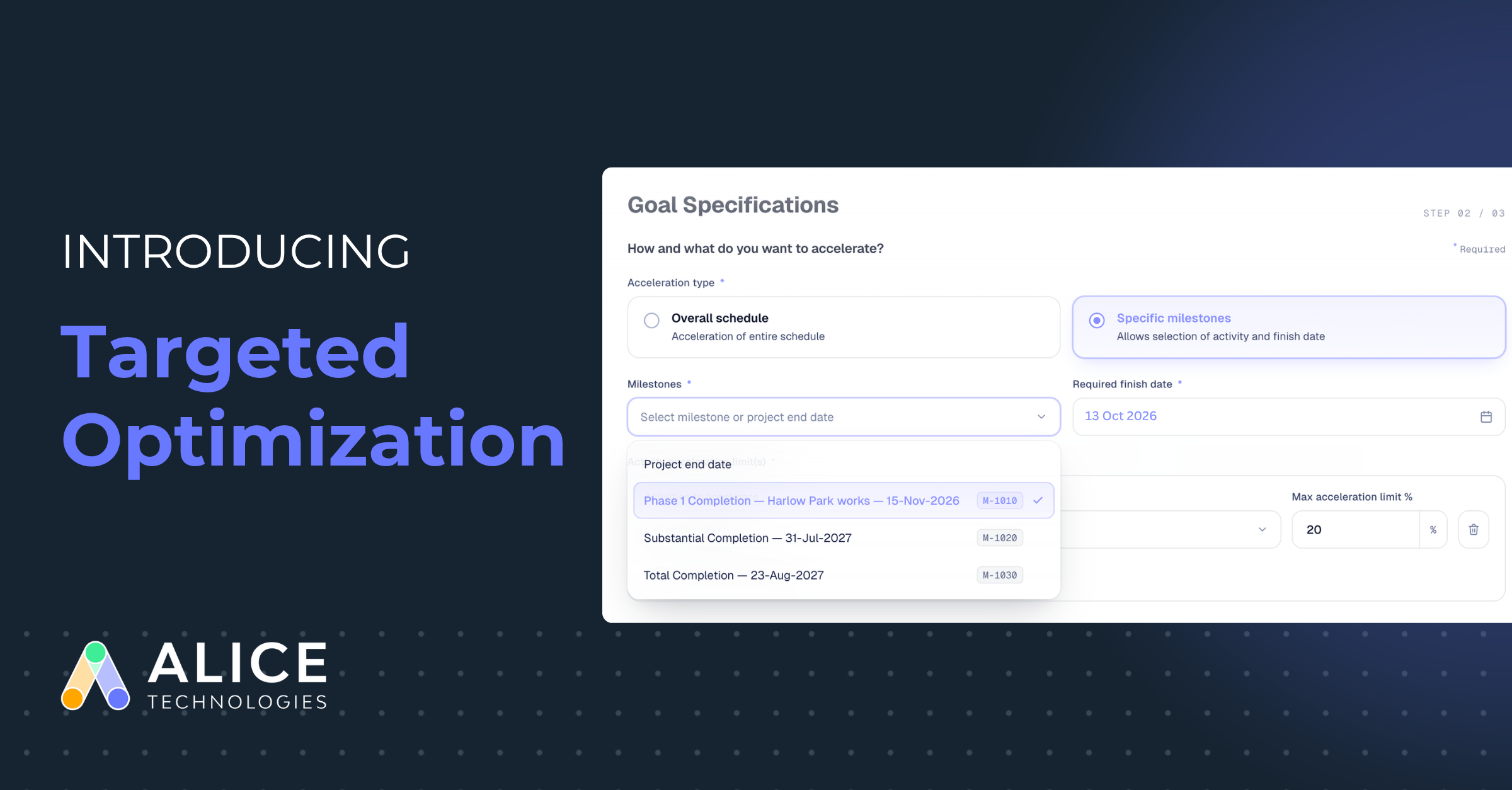
ALICE Technologies, the creator of the world’s first generative scheduling platform, today announced the general availability of Targeted Optimization, a new optimization mode within ALICE that helps construction teams identify and act on the highest-impact acceleration opportunities in their schedule.
Construction schedules are among the most consequential documents on a project. They do more than just serve as an outline. They shape scope, cost, risk, resource allocation and utilization, and delivery timelines. So, when something slips, the impact extends far beyond a delayed finish date. It triggers a cascading effect that can leave teams making critical decisions with inadequate information.
Procurement delays, shifting dependencies, and unforeseen constraints regularly threaten milestones that are critical to cost, delivery, and client commitments:
- Which tasks are driving the problem?
- Where should productivity improve?
- What is the most feasible path to recovery from a two-month delay?
Targeted Optimization was built to answer these questions and provide immediate clarity on where acceleration efforts will have the greatest impact.
Here’s what it looks like in practice
One team working on an industrial construction project with more than 16,000-line schedule was attempting to accelerate mechanical completion but struggled to identify which activities would deliver the greatest impact. Targeted Optimization surfaced 30 tasks that, if adjusted, would create the most schedule gains and accelerate the mechanical completion milestone.
“I have a target date in mind and now, I can receive a plan that tells me how to achieve it,” added the user working on that capital project. “Previously, it was a game of Whac-A-Mole: test your best guess — and well, answering one scenario took days worth of effort in, let alone evaluating another.”
Targeted Optimization focuses on a specific user-defined objective, such as a milestone date, the project completion date, a selection of tasks, or the overall schedule. ALICE rapidly evaluates numerous potential solutions and surfaces ones that can deliver the most impactful schedule gains, giving teams a clear and actionable plan.
This includes strong visibility into near-critical path drivers — tasks that sit just outside the critical path but often have an outsized impact on schedule performance — enabling teams to make faster, more confident decisions about where to focus acceleration efforts. Unlike manual analysis, which often centers on the most obvious critical activities, Targeted Optimization helps uncover less visible drivers that can significantly impact project duration.
In another example involving a major data center build, Targeted Optimization revealed 5 tasks within a 42,000-line schedule that could drive a faster phase 1 completion.
One of the first teams to apply Targeted Optimization was Suffolk Construction, who deployed ALICE on a life sciences development where schedule certainty was critical to project success. Procurement delays and external dependencies had introduced negative float on a key milestone, and the team needed a clear path to recovery. The scheduling team first leveraged ALICE’s Schedule Insights Agent to identify resequencing opportunities, effectively reducing negative float by 22 days.
They then ran Targeted Optimization to identify where additional acceleration was possible. ALICE surfaced three trade tasks where a 30% productivity improvement would drive significant schedule gains, enabling the team to concentrate effort precisely where it would have the most impact. Together, the two capabilities helped Suffolk recover a total of 42 days, eliminating negative float on critical milestones and maintaining cost and timeline control despite the earlier disruptions.
“ALICE delivers real tactical value to our teams by helping us surface optimizations, validate opportunities, and clearly communicate schedule updates and reasoning with stakeholders," said Dawn Polley, Director of Scheduling at Suffolk Construction.
Because Targeted Optimization works without requiring a fully resource-loaded schedule, any project team can identify acceleration opportunities in minutes. Furthermore, results are paired with clear reasoning like measuring quality and variance between optimized schedules, so teams can validate the logic, communicate the strategy to stakeholders, and move forward with confidence.
"Project teams don't always need to optimize everything at once," said René Morkos, Founder and CEO of ALICE Technologies.
"Sometimes the goal is to target a specific date, protect a critical handover, or answer a difficult question rooted in their schedule data. Targeted Optimization gives teams that capability — fast answers grounded in the actual logic of their schedule, backed by the full optimization power of ALICE.”
Targeted Optimization joins the primary Resource Optimization mode in ALICE, giving teams two distinct and complementary modes depending on their objective. Where Resource Optimization enables comprehensive schedule optimization across crews, equipment, costs and dependent constraints, Targeted Optimization is designed for speed and precision when teams need to evaluate a specific outcome or acceleration strategy quickly. It makes advanced schedule acceleration insights accessible to a broader range of construction professionals from project executives and project managers to field teams and more.
Targeted Optimization is now generally available within ALICE Optimize. Request a demo here.
ALICE Technologies is the world’s first AI-powered construction simulation and optimization platform. It helps contractors, owners, and consultants de-risk, optimize, and recover from delays by providing powerful tools for schedule visualization, optimal solution generation, and analysis. With ALICE, teams can explore countless ways to build their projects, choose the most efficient path, and stay on track even when conditions change. The company works with large customers worldwide in the infrastructure, industrial, and commercial construction segments.