


Construction software is entering a new phase, but not necessarily the one the industry expected.
Over the past year, major platforms have moved to include free scheduling tools with their existing product offerings, treating one of construction's most critical workflows as an add-on. On the surface this appears to be progress, but in reality it only creates deeper problems on the job site and makes project delays harder to prevent.
Scheduling was never meant to be an add-on. It is the brain of your project. The schedule holds critical, time-sensitive data and context from across your entire project, and should never be treated as an afterthought or a checkbox.
Today, construction teams operate across fragmented systems, including scheduling tools, RFIs, submittals, and field updates. Each system functions independently, with no unified source of truth. The result is a persistent gap between planning and execution, where decisions are made without real-time alignment and delays compound across teams.
Industry data continues to show that coordination breakdowns are one of the leading causes of project overruns. This is not because tools are unavailable, but because they are not connected in a way that reflects how projects actually operate.
Outbuild, a construction scheduling and planning platform, is introducing a different approach that rethinks the role of the schedule entirely.
From Scheduling Tool to System of Intelligence
Rather than treating scheduling as a standalone function, Outbuild positions it as the central data layer of the project. It becomes the place where planning, field activity, and decision-making converge.
The company refers to this approach as Project Intelligence. In this model, the schedule serves as the foundation for understanding what is happening across a project, what is at risk, and what actions need to be taken.
“Construction does not have a true system of record for how projects actually run,” said Franco Giaquinto, CEO of Outbuild. “Everything ultimately ties back to the schedule, but the schedule has not been structured to support that role. That is the gap we are solving.”
This shift comes at a time when construction teams are under increasing pressure to deliver projects faster and with greater predictability, while managing growing complexity.
Why Free Scheduling Does Not Solve the Problem
The introduction of free scheduling tools reflects a broader trend. Core functionality in construction software is becoming easier to access, but not necessarily more effective.
While these tools lower the barrier to entry, they do not address the underlying issue.
Project data remains fragmented across systems. Field updates are not reflected in the schedule in real time. Critical workflows such as RFIs and submittals remain disconnected from execution timelines.
In many cases, this creates a situation where teams appear to be on schedule, but are operationally misaligned.
“Making scheduling free does not fix coordination,” said Giaquinto. “It simply makes the gap more visible.”
Building the Missing Layer in Construction
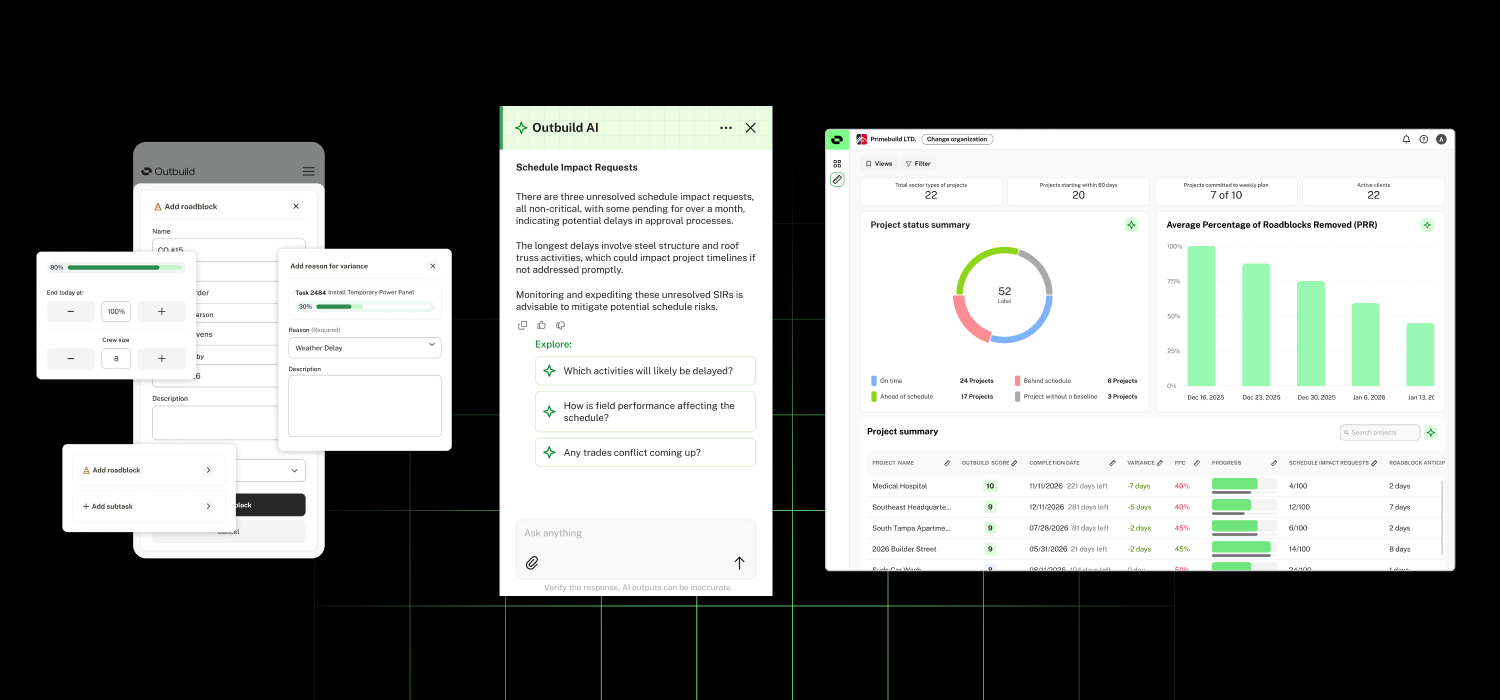
Outbuild’s Project Intelligence approach focuses on connecting project data through the schedule.
Key capabilities include real-time field-to-schedule updates through mobile workflows, structured delay capture and impact analysis, visibility across projects and portfolios, and AI-assisted insights that help teams understand risk and next steps.
Rather than introducing additional disconnected tools, the goal is to make the schedule the place where critical project information is unified.
A Shift Already Underway in the Field
This approach is already being applied on large-scale projects, including complex environments with multiple stakeholders where coordination is critical.
In these settings, teams use the schedule not only for planning, but as a live operational system that reflects real-time conditions on the jobsite.
The result is faster identification of risks, improved alignment between field teams and leadership, and greater confidence in project outcomes.
What Comes Next
As construction technology continues to evolve, the question is no longer whether teams have access to scheduling tools. The question is whether those tools can support the full complexity of modern projects.
Outbuild’s view is that the next phase of construction software will be defined by how well systems are connected and where intelligence resides within the workflow.
Increasingly, that foundation is the schedule.
About Outbuild
Outbuild is a construction planning and scheduling platform designed to help contractors plan smarter and execute with greater certainty. By connecting the master schedule, lookaheads, and field workflows into a single system, Outbuild gives construction teams the visibility and intelligence they need to deliver projects more predictably.
Learn more at www.outbuild.com.