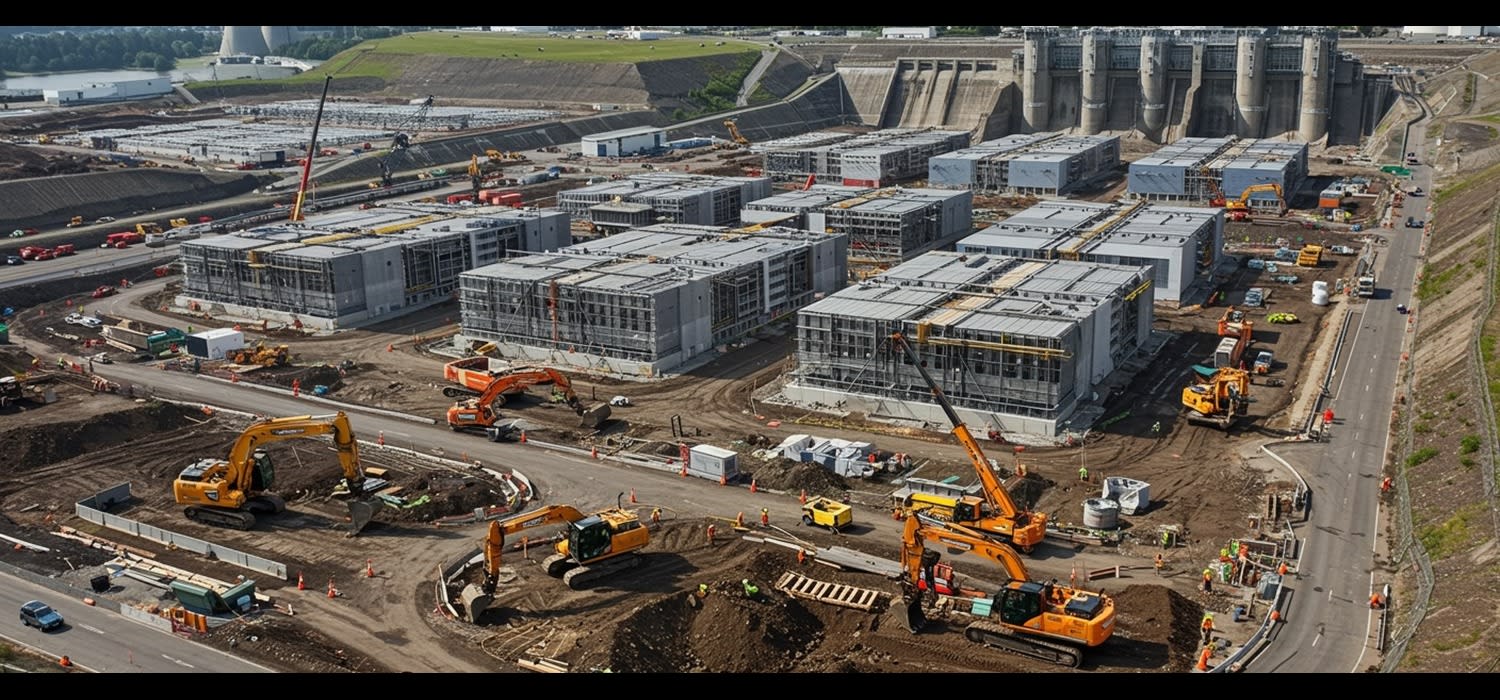
The rapid global expansion of data-center construction is creating a new generation of jobsite safety challenges, according to a new industry analysis from Safety Systems Management, a provider of wireless emergency notification systems for construction environments.
Driven by surging demand for cloud computing, artificial intelligence workloads, and hyperscale storage, the global data-center construction market—valued at $240.97 billion in 2024—is projected to reach $456.5 billion by 2030, growing at a compound annual growth rate of 11.8 percent. As projects grow larger, faster, and more complex, construction safety professionals warn that traditional safety communication methods may no longer be sufficient.
“Data centers are among the most technologically advanced facilities in the world, but building them can be incredibly challenging from a safety perspective,” said Cory Sherman, CEO of Safety Systems Management. “These projects involve massive campuses, high-energy electrical infrastructure, constantly changing schedules, and thousands of workers moving across multiple buildings. Without modern communication tools, safety teams can struggle to respond quickly when incidents occur.”
According to Sherman, several factors make data-center construction fundamentally different from traditional commercial construction projects.
Eight Emerging Safety Risks in Data-Center Construction
Safety Systems Management identifies the following key challenges now shaping jobsite safety on data-center projects:
• Massive Project Scale – Hyperscale campuses can span hundreds of acres and multiple buildings, making it difficult to reach all workers quickly during emergencies.
• Simultaneous Multi-Building Construction – Data halls, substations, cooling towers, and power infrastructure are often built at the same time, increasing the potential for overlapping hazards.
• Remote Jobsite Locations – Many data centers are intentionally built in isolated areas where emergency services may be miles away, increasing the importance of fast on-site communication.
• High-Energy Electrical Systems – Crews frequently work near energized switchgear, generators, and distribution systems, where arc-flash incidents require immediate notification and coordinated response.
• Rapidly Changing Construction Plans – Accelerated project timelines driven by digital-infrastructure demand often cause daily changes in sequencing, logistics, and site access.
• Transient Workforce – Large projects can involve thousands of workers cycling on and off the site, making consistent safety communication difficult.
• Weather and Environmental Hazards – Large, exposed campuses are particularly vulnerable to severe weather events such as lightning, high winds, heat waves, and wildfire smoke.
• Manual Emergency Mustering – Confirming that all workers have evacuated safely across multiple buildings can be slow and error-prone when done manually.
Sherman says many of these challenges stem from the difficulty of communicating with large numbers of workers across sprawling jobsite environments.
Traditional jobsite alerts such as air horns, radios, and verbal instructions often fail over long distances or through sound-dampening construction materials. Wireless emergency notification systems, however, allow safety managers to instantly send alerts to workers through multiple channels simultaneously, including wearables, mobile devices, sirens, and strobe systems.
These systems can also provide zone-based alerts, enabling safety managers to evacuate a specific building or area without disrupting the entire project. In the event of a medical emergency or electrical incident, they can significantly shorten response time by directing crews and first responders to the exact location of the hazard.
“Data-center construction is only going to accelerate as digital infrastructure becomes more critical to the global economy,” Sherman said. “To keep workers safe in these complex environments, the industry needs communication systems that are just as advanced as the facilities being built.”
Safety Systems Management provides wireless emergency notification and communication systems designed for complex jobsite environments, including large-scale construction projects, industrial facilities, and infrastructure developments. The company’s technology enables real-time alerts, targeted messaging, and rapid emergency response coordination to improve worker safety and reduce incident response time. Visit Safety Systems Management.