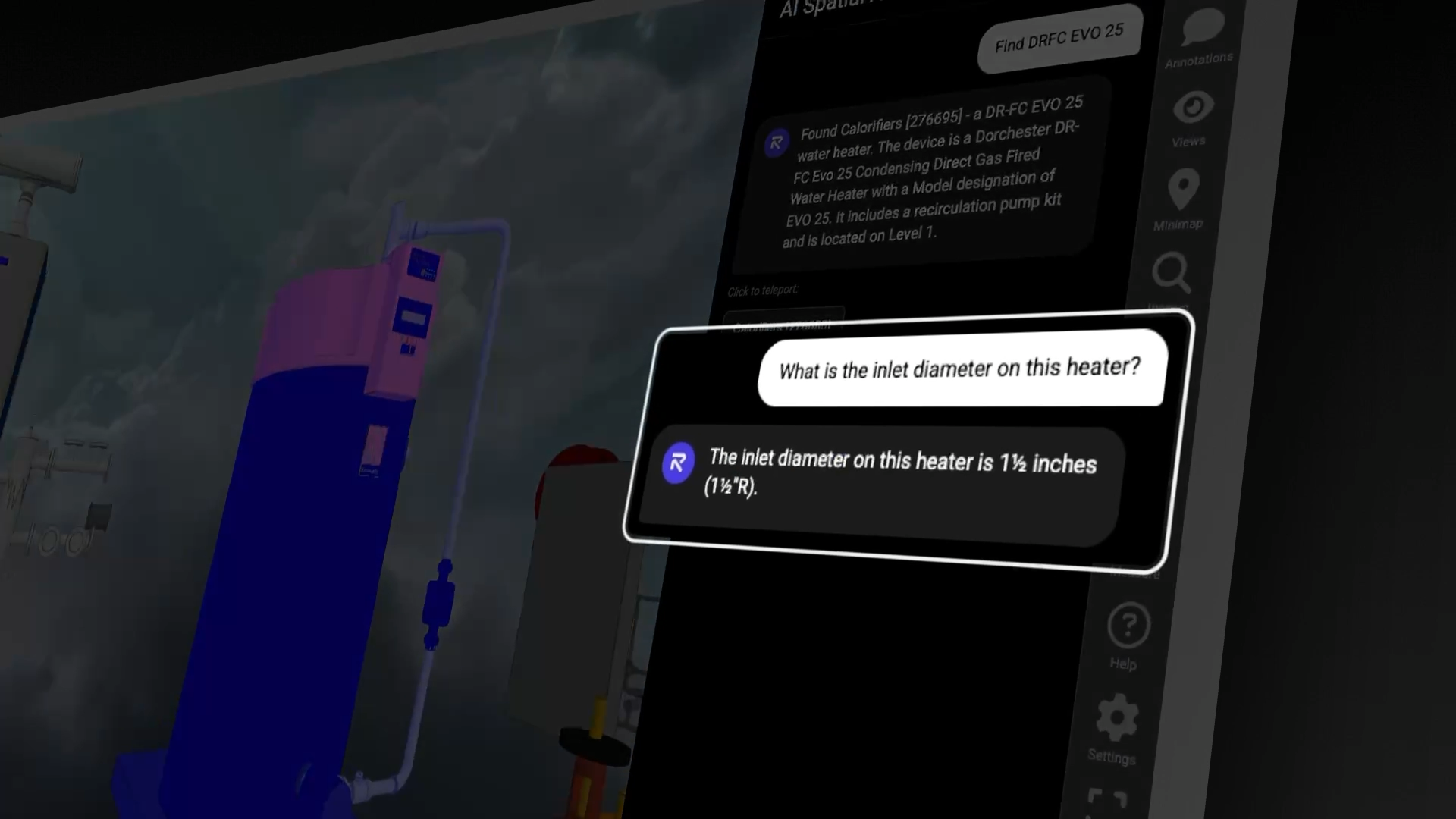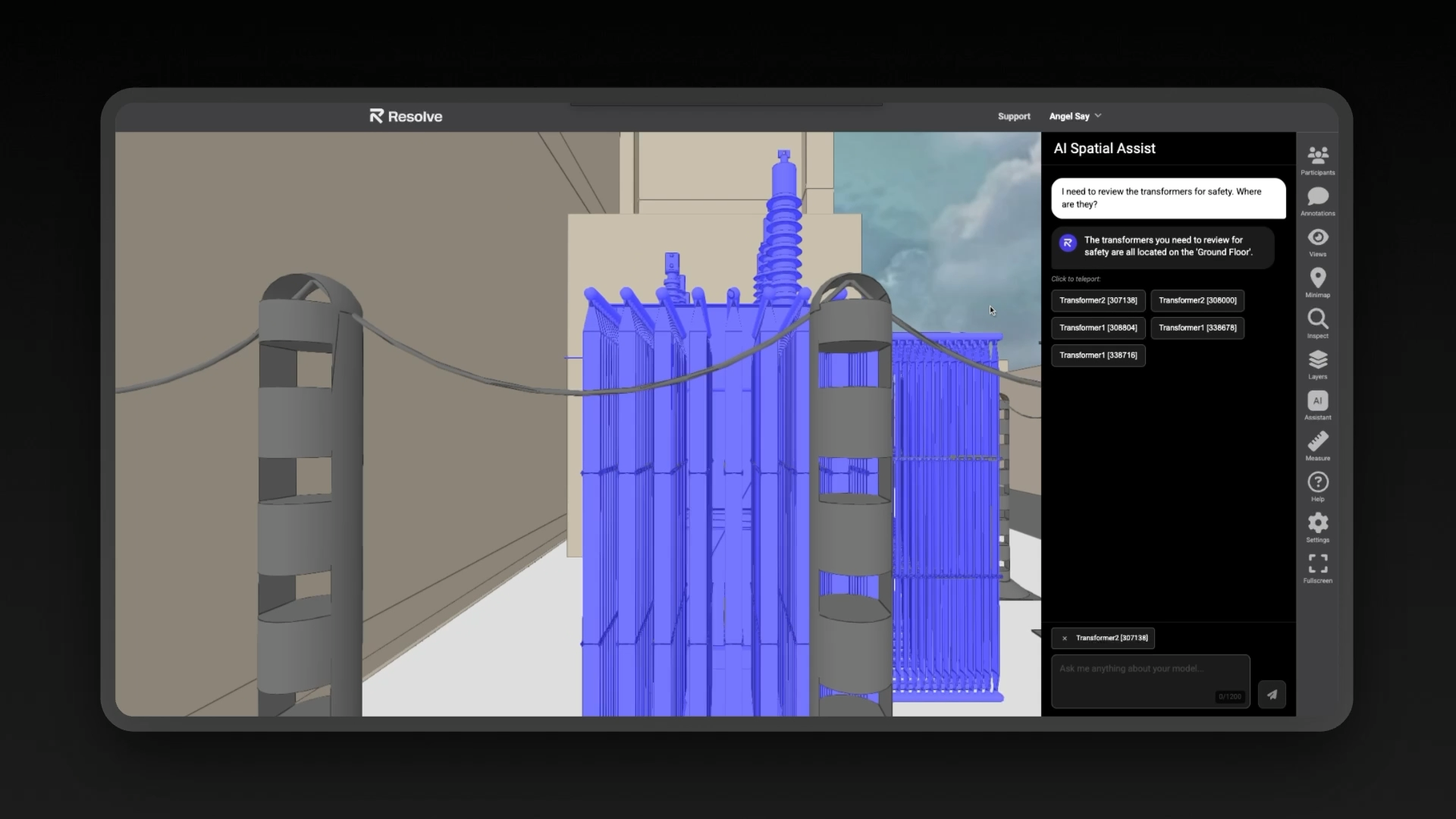



February 9, 2026 — Resolve, the Design-Delivery Alignment platform for mission-critical infrastructure, today announced the launch of AI Spatial Assist, a new AI capability that allows anyone, regardless of BIM expertise, to instantly navigate, interrogate, and review complex building models using natural language.
Available across Resolve’s high-performance web viewer and immersive VR environment, AI Spatial Assist enables teams to ask questions, locate equipment, teleport to rooms, and navigate models in seconds without relying on technical specialists or complex software interfaces.
The launch addresses one of construction’s most persistent productivity drains: the time it takes to find and validate project information.
Industry research shows project teams spend roughly 20% of the time in meetings or long communication threads and another 14% tracking down information each week. A significant portion of that time is spent doing model reviews, scheduling coordination sessions, screen-sharing navigation, and relying on BIM specialists to retrieve answers locked inside complex 3D environments.
Yet despite this massive coordination investment, many projects still suffer costly downstream rework.
When operability constraints, installation conflicts, or access issues go unnoticed during design, they surface later during procurement, installation, or commissioning. And at a time where the demands for AI infrastructure are higher than ever, the industry cannot afford these delays.
Eliminating the BIM Bottleneck
Historically, BIM review has depended on BIM/VDC specialists to operate software, navigate geometry, and extract insights. This created an operational bottleneck where subject matter experts, from facilities leaders to field teams, can’t easily validate design models on their own.
AI Spatial Assist removes that dependency and frees up VDC teams for higher impact work.
Users can simply ask:
- “Take me to the electrical room on Level 2.”
- “Where are the cooling towers located?”
- “Which P&ID is this valve a part of?”
The AI agent understands BIM geometry and metadata for seamless navigation and understanding of complex 3D models. If you've clicked on an object in the model, the agent will also use that context to answer questions like “what is this?”
Improving Speed and Quality at the Same Time
AI Spatial Assist is designed to improve both delivery velocity and quality simultaneously.
By making BIM instantly accessible, the platform eliminates meetings whose sole purpose is navigating models or retrieving information. Subject matter experts can review directly, validate assumptions earlier, and flag risks without waiting on technical intermediaries.
At the same time, broader participation leads to better outcomes. Facilities teams validate maintainability. Field leaders assess install risks. Operators confirm equipment access and safety, all before construction begins.
Feedback cycles are compressed from weeks to minutes and deliverables are better aligned with the realities of construction and operations.
“Speed and quality have historically been treated as tradeoffs,” said Angel Say, CEO of Resolve. “You either move fast and accept risk, or slow down to reduce it. Our vision is eliminating that tradeoff entirely. When reviews are effortless, you go faster because quality is higher, not in spite of it.”
Capturing What Rules-Based AI Misses
Many emerging AI tools in design and construction focus on rules-based validation by checking models against documented requirements such as permitting regulations, building codes, and engineering standards.
While critical, these systems operate on knowledge that is already written down.
Some of construction’s highest-value intelligence, however, is rarely formally documented.
Operational feedback about maintainability, service access, installation practicality, and real-world usability lives primarily in the experience of facilities leaders, operators, and field teams. Historically, this expertise has been difficult to capture, easy to lose between projects, and rarely incorporated upstream into design.
As the industry faces a growing labor shortage and generational workforce transition, preserving and scaling this knowledge is becoming increasingly urgent.
By making BIM models instantly accessible through natural language, AI Spatial Assist enables these stakeholders to engage directly allowing teams to capture and structure feedback that would otherwise remain siloed or lost.
The First Step Toward Compounding Intelligence
Resolve positions AI Spatial Assist as the foundation of a broader vision. One where every project review strengthens the next.
Each interaction generates structured insight: risks identified, access issues flagged, coordination conflicts surfaced, and operational feedback captured. Over time, this creates a growing intelligence layer across infrastructure portfolios.
“In an AI-enabled future, it’s even more important that humans can efficiently review deliverables,” says Resolve COO Russell Varriale. “Our goal is to amplify human judgment so reviews happen earlier, faster, and with greater confidence. We want teams to move from design to construction at the speed of light.”
Resolve AI Spatial Assist is rolling out to select partners today and teams can sign up for the waitlist at https://www.resolvebim.com/ai
Resolve is the Design-Delivery Alignment platform helping companies build mission critical infrastructure as fast as the future demands.
By combining complete BIM intelligence, immersive VR reviews, and AI-driven spatial navigation, Resolve closes the gap between design intent and field execution, empowering teams to identify rework risks earlier, coordinate faster, and deliver higher-quality assets across mission-critical infrastructure.
To date, over 6GW of data center capacity have been delivered with Resolve. Projects across data centers, healthcare, semiconductors, water treatment, and other major verticals have used Resolve to build faster.