It’s no secret that data center construction was the beating heart of the building industry in 2025.
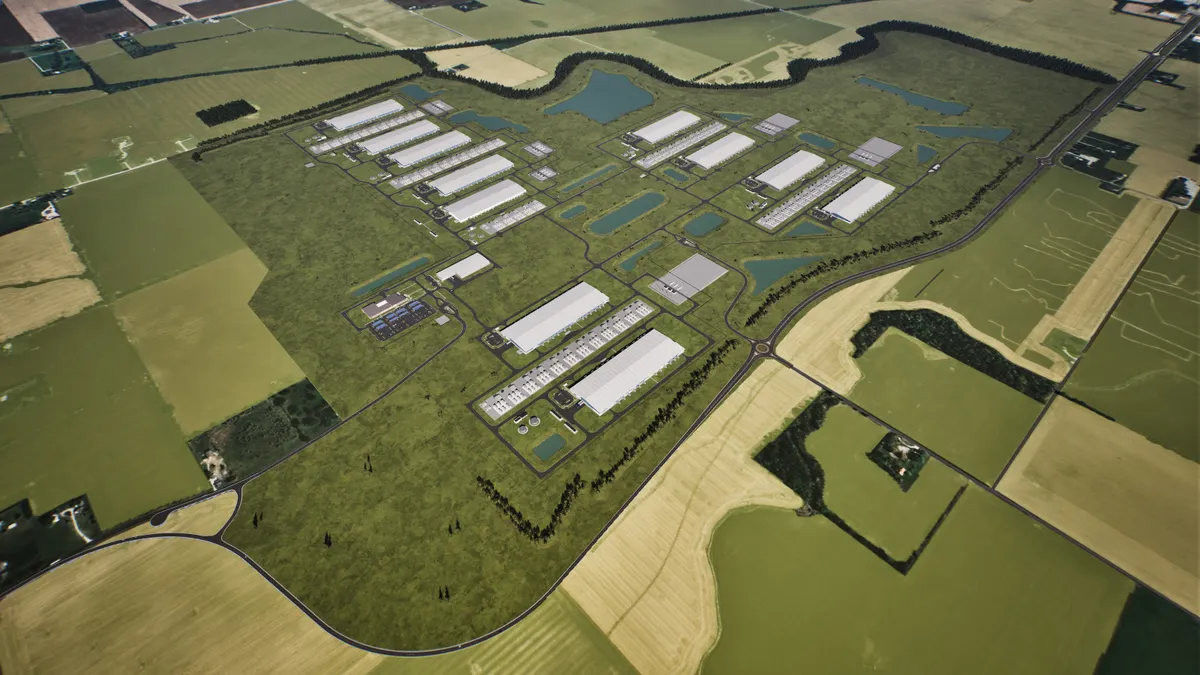
Last January, a collection of tech giants committed up to $500 billion to build data centers across the U.S. Throughout the year, the so-called Stargate initiative kept pace on its project planning pipeline, announcing buildouts in Texas, New Mexico, Ohio and the Midwest.
For builders, these multibillion-dollar builds have been a bright spot in an otherwise languishing construction industry. Large public builders have touted data centers as a focus for their construction units, per their earnings calls. These projects also propelled construction planning numbers higher to end the year, and many builders believe that data centers will continue to be one of the biggest trends of 2026.
Indeed, the projected numbers for the AI infrastructure buildout are staggering. Credit ratings agency Moody’s now projects $3 trillion in global spending over the next five years to keep pace with rapid data center expansion and AI capacity demand.
Data center investments are projected to increase
Alongside projected business demand for data center construction, however, contractors also believe AI will fundamentally change their businesses, according to a survey from Dodge Construction Network. Investors think so, too: AI-based technologies, along with robotics, nabbed $2.22 billion in built environment funding through the end Q3 2025, according to a report from Nymbl Ventures. Those dollars and demand for data center projects continue to roll in, even as fears of a possible AI bubble persist.
So what exactly does the deluge of data center projects, and the push for AI adoption, mean for construction at the end of the day?
Is this simply another building boom, where contractors will literally lay foundations — for a price, of course — and walk away once those facilities are built? Or does it represent an opportunity for the construction industry to fully embrace technology in the ongoing AI arms race?
Experts say the answer is affirmative for both.
While some builders will leverage the boom into lucrative construction contracts to manage the work, other firms can get in on the infrastructure, the power plants, the roads and a plethora of other tangential buildouts needed to support the work, industry experts told Construction Dive.
“As the U.S. works to expand grid capacity to support energy-intensive AI workloads, a significant share of related work is occurring around the data center rather than within the building footprint, creating opportunities for smaller civil, utility, and specialty firms to participate.”

Macrina Wilkins
Senior research analyst, Associated General Contractors of America
At the same time, the AI technology fueling the boom presents opportunities for builders to catch up to other industries and leverage technology to their advantage.
A double-edged game changer

The impact of AI on construction is “twofold,” said Macrina Wilkins, senior research analyst at Associated General Contractors of America. The technology is improving project and building opportunities in data center construction, while also turbocharging the way contractors run their businesses.
“You have it reshaping how contractors are estimating, how they’re doing their scheduling, how they're managing projects,” Wilkins said. “But it’s also driving demand for data centers, construction, substations, electrical infrastructure.”
Indeed, the AGC’s 2026 Outlook Survey reported that data centers and power facilities represent the lion’s share of project opportunities this year. Outside of those areas, builders have “dampened” expectations for the construction industry amid economic uncertainty.
Picks and shovels
The scope and scale of the AI buildout present opportunities for firms beyond just those with the skill, size and expertise to handle multibillion-dollar projects. Other contractors can get in on the action as well, according to Ryan Kunisch, vice president of global product for tech giant Oracle, one of the global firms at the center of the AI data center push.

“You have a small set of large owners who are really driving the demand, whether it’s the utility companies or the data center owners themselves,” Kunisch said. “But really, the bottom of that pyramid [is a] huge opportunity for the trades, even for, as I mentioned, the logistics to accomplish some of these massive projects.”
Just look at Watsonville, California-based Granite Construction. While the firm hasn’t presented itself as a data center builder, it has highlighted its picks and shovels strategy of creating roads and other infrastructure for data center buildouts in its earnings calls.
“As the U.S. works to expand grid capacity to support energy-intensive AI workloads, a significant share of related work is occurring around the data center rather than within the building footprint, creating opportunities for smaller civil, utility, and specialty firms to participate,” Wilkins said via email.
Bubble fears
Despite these projections and perceived opportunities, fears remain, namely bubble fears over the so-called AI trade that roiled the stock market at the end of 2025.
"A major pullback in investment [and] in valuations on AI and data centers could obviously have a very significant impact on [builders]."
Will Senner
Senior VP of preconstruction and data solutions team leader, Skanska USA Building
Take the skittishness investors showed over chip giant Nvidia’s Q3 earnings: The AI darling posted a near-perfect quarter, disproving “pretty much all of the bear cases out there,” according to CNBC. Still, the stock gave back its initial gains as bubble fears continued to nibble around the edges of the boom.

Indeed, should the projected demand for AI infrastructure not play out as anticipated, with the amount of cash and debt financing fueling the trend, the collapse of data center buildouts could be disastrous.
“If there are companies out there who have become overly reliant on data centers and it's become a very significant portion of their portfolio, I think a major pullback in investment, in valuations on AI and data centers could obviously have a very significant impact on their business,” said Will Senner, senior VP of preconstruction for Skanska USA Building and the leader of its data solution team. “Hopefully, [they’d] be in position to be able to pivot to other market sectors and other project types.”
Oracle’s Kunisch acknowledged the froth surrounding the sector’s projected growth as well, though believes AI is here to stay, as providers including Oracle find ways to make it useful for customers.
“The proof will be in the pudding, so to speak,” Kunisch said. “Meaning that as we start to document the return on investment, look at efficiencies, find areas to avoid the use of AI or even dial back the overarching panacea of promise and get to some real metrics, I think you’ll start to see stabilization in all of this.”
Innovation station
Outside of fueling demand for data centers and surrounding infrastructure, AI can help builders streamline how they run their businesses.
“We’re seeing lots of innovation, lots of people working to overcome challenges like labor shortages, or challenges like remote versus near urban environments,” said Chris Gorthy, the leader of Redwood City, California-based DPR’s Advanced Technology core market group. That push, along with the demand for the facilities themselves, has been driven, in part, by an “insatiable need for data in every aspect of our lives,” Gorthy added.
There are downstream openings for smaller contractors as well.
“I think one of the really exciting, but also potentially challenging, components of this AI transformation is the ability to enable everyday users in the business to develop their own solutions,” Skanska USA Building’s Senner said. “A lot of these tools are becoming more and more low code or no code, meaning you don’t have to be a data scientist to quickly create your own AI tool or AI agent.”
Senner points to Skanska’s Citizen Developer Program, which trains users in the company on how to create and use their own AI tools following proper data guidelines.
However, builders without a robust and accurate data infrastructure or vetting system could run into problems.
That said, as Skanska and other large contractors, including Turner Construction, adopt these AI tools, smaller builders should also benefit, just as BIM, project management and VDC platforms have trickled down construction’s tech stack in recent years.

In fact, AGC is working to help smaller contractors take advantage of AI, pitching education and outreach to builders in lower revenue brackets.
“If we’re not moving together as an industry, then we’re not moving forward,” said Sarah Gallegos, senior director of the building division and construction innovation at AGC. “We can't leave the small- to mid-size contractors behind.”
Small contractors, Gallegos said, are using AI less as a shiny tool and more as a force multiplier. Examples include speeding up estimating, leveling the playing field in marketing and proposals and streamlining administrative work.

Overall, AI adoption will continue to be slow and steady, said Chris Love, AGC’s vice president of association and industry innovation. It will even happen incidentally, as large contech providers such as Procore, which are used by builders of all shapes and sizes, add AI to their product offerings.
“There are always going to be people that are more on the bleeding edge, but I think as more of the traditional companies see that and see the success they’re having, and worry about being left behind, I think we’ll continue to see adoption,” Love said.