A major, Chicago-based contractor is seeking to power up its ability to deliver data centers and advanced manufacturing jobs.
Clayco, a full-service construction firm, recently launched Power and Energy, a new business unit focused on the rapidly growing energy sector, according to a March 4 company news release. The unit will provide design, engineering, procurement and construction services for energy infrastructure nationwide.
The rapid expansion of data centers, domestic manufacturing, transportation electrification and residential will push electricity demand to grow by 15% to 20% by 2030, according to the release. Newly available renewable power sources are meeting that jump in demand, especially solar.
For that reason, Clayco expects the new unit to generate $300 million in revenue by 2027, according to the company. The builder is already under contract and in the design phase for a solar and battery storage project in Illinois, scheduled to mobilize this year.
Here, Clayco CEO Anthony Johnson talks with Construction Dive about why the firm launched the new Power and Energy unit, how power generation fits into megaproject developments and what challenges the buildout effort could face.
This interview has been edited for brevity and clarity.
CONSTRUCTION DIVE: How does bringing power generation into Clayco’s delivery model change how the approach to large development such as data centers?
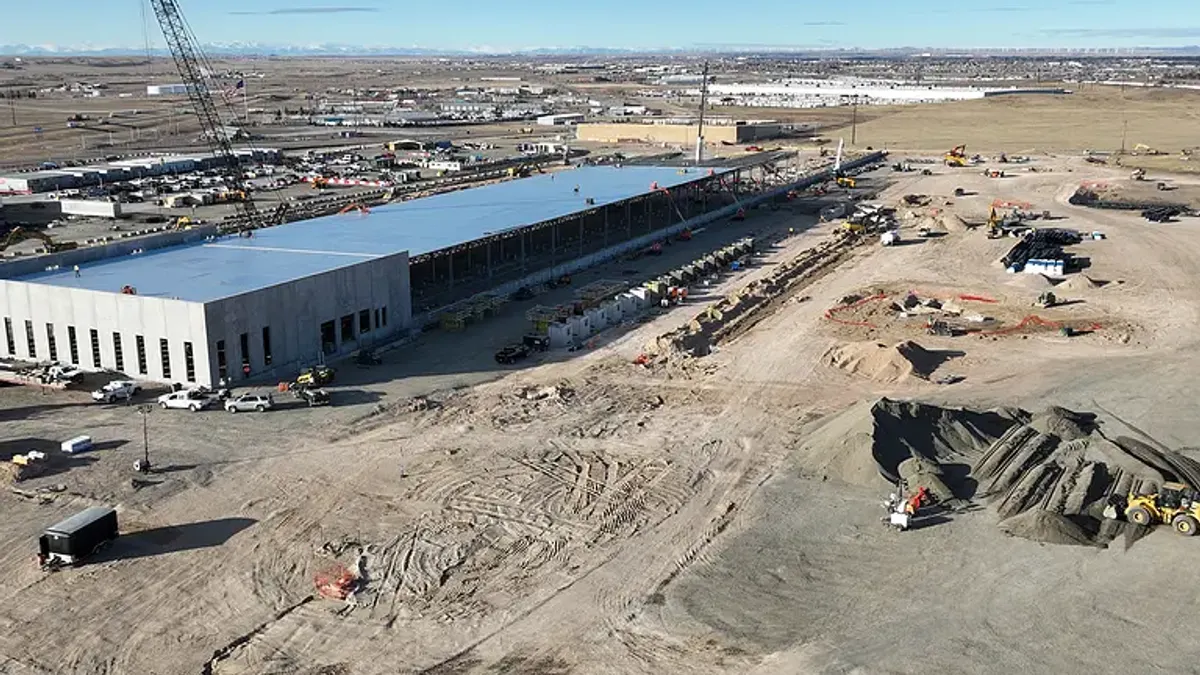
ANTHONY JOHNSON: Clayco is a leader in advanced technology construction and a top five data center builder in the United States, with 57 data center projects actively underway across the country. With the launch of Clayco Power and Energy, we are extending our integrated design-build model into utility-scale energy infrastructure.

Access to affordable, reliable and sustainable power has become essential for modern infrastructure. With the rapid expansion of advanced technology facilities, including data centers that are critical to innovation, economic growth and national security, the U.S. energy sector is at an important inflection point.
Solar will play a meaningful role in meeting that demand alongside other energy sources such as natural gas and nuclear. It remains one of the fastest forms of power generation to bring online, and in 2025 approximately 85% of new electric generating capacity added in the United States came from solar and battery storage.
Clayco Power and Energy’s role is to execute and deliver design, engineering, procurement and construction services at scale to accelerate the deployment of reliable, cost-effective energy infrastructure across the United States. As part of that effort, we anticipate partnering with utilities, solar panel manufacturers, energy storage battery providers, developers, independent power producers and large energy users to help deliver solar and energy storage projects nationwide.
What competitive advantage does an integrated power and construction offering give Clayco?
Clayco is now the largest data center builder with a dedicated energy team in the United States.
As a leader in large scale integrated project delivery, the launch of Power and Energy allows us to bring the precision, innovation, speed-to-market and performance we’re known for to the energy sector. With end-to-end design, engineering, procurement and construction under one roof, our fully integrated model minimizes risk, accelerates schedules and maximizes value for clients looking to incorporate power generation and storage into their advanced technology projects.
Do you expect onsite power generation to become standard for large facilities?
As demand on the United States’ energy grid increases with the continued advent of advanced technological facilities, onsite power generation will be critical to meeting that demand. Encouragingly, we are seeing the appetite for onsite power generation climb. Owners of data centers and advanced manufacturing facilities are increasingly looking to provide their own power supply through the construction of utility-scale solar and battery energy storage projects.
Most recently, hyperscalers have committed to signing a pledge to build, bring or buy their own power supply for new AI data centers and have also expressed a willingness to foot the bill for infrastructure upgrades required to connect to the grid so that Americans’ electricity bills will not increase as AI demand grows.
How much did data center power demand influence Clayco’s decision to launch this unit?
Given the ever-expanding need for electricity, employing solar energy, alongside other energy sources such as natural gas and nuclear, is imperative to reaching a broader solution.
Interestingly, 85% of all new electric generating capacity brought online in the U.S. was composed of solar and battery storage last year. Solar remains one of the fastest forms of power generation to bring online.
While data center power demand is certainly a key component of this, Clayco Power and Energy will serve a diverse group of clients, including utilities, independent power producers, financial sponsors and advanced manufacturing facilities.
What challenges do you expect?
Large-scale infrastructure projects across the energy and technology sectors are taking place at a time when demand for skilled labor in construction, engineering and energy infrastructure continues to grow.
As investment in data centers and power generation accelerates, workforce availability and recruitment remain important considerations for projects of this scale.
Are there any other trends you are keeping tabs on?
As we look to upgrade America’s aging grid infrastructure and meet the increasing demand for energy nationwide, solar must be part of the solution. Solar energy is the fastest type of power to bring to the market, and should be part of a multivariable approach — along with fossil fuels, natural gas and nuclear — to address America’s growing energy needs. As demand on the United States’ energy grid increases with the continued rise of advanced technological facilities, leveraging all forms of energy, including solar, is critical to technological innovation, the U.S. economy and our long-term national security.